
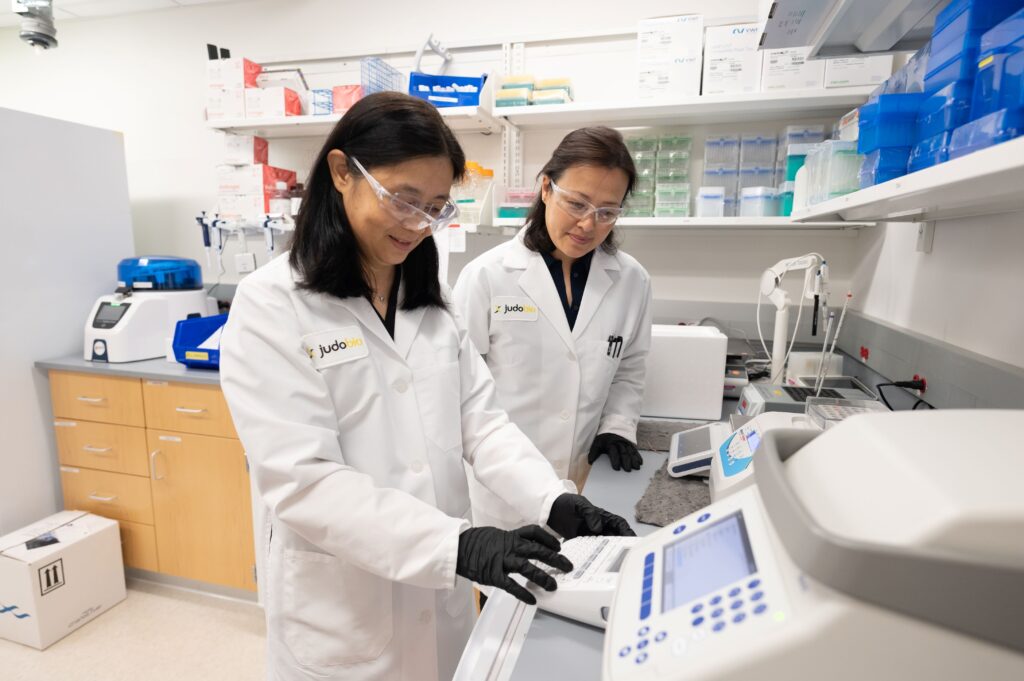

A startup focused on developing oligonucleotide-based silent RNA treatments for systemic and renal diseases is emerging from stealth mode, launching with $100 million in combined seed and oversubscribed Series A financing, and a discovery approach similar to that of another Atlas Venture founded and incubated drug developer, Alnylam Pharmaceuticals.
Just as Alnylam a decade ago pioneered small interfering RNA (siRNA) drug development by creating conjugates that combined the sugar molecule GalNAc with siRNAs, an approach applied in the company’s four FDA-approved treatments starting in 2018 with Onpattro™ (patisiran), newly launched Judo Bio aims to develop ligand-siRNA conjugates through its Selectively Targeting RNA Into KidnEy (STRIKE) platform.
The conjugates bind to megalin receptors, which are highly expressed on proximal tubule epithelial cells (PTECs) in the kidney. Because megalin is rapidly internalized, slowly degraded, with high recycling capacity, Judo reasons that megalin is an ideal entry point for intracellular delivery of a ligand-siRNA conjugate.
Once internalized, the conjugates—called megalin-STRIKERS—are designed to degrade and thus silence target messenger RNA (mRNA), resulting in a reduction of specific solute carrier (SLC) proteins. The SLC proteins constitute a protein family consisting of hundreds of transporters in the kidney that contribute to the homeostasis of circulating substances, including amino acids, electrolytes, glucose, and other metabolites.
Judo Bio reasons that SLC proteins present numerous opportunities to develop megalin-STRIKERS for these targets by achieving knockdown of the genes that express SLC proteins in the kidney. Megalin-STRIKERS are designed to overcome the direct excretion of oligonucleotides such as RNA when they reach the kidney.
The company has identified systemic diseases as its initial areas of focus.
“Our initial march toward the clinic will be with systemic diseases, and thereafter with renal diseases,” Judo Bio CEO Rajiv Patni, MD, told GEN Edge. “The systemic diseases we’re going after, which can be modulated with the proximal tubule, include but are not limited to inborn errors of metabolism, gout, hypertension, heart failure, type 2 diabetes, other disorders of electrolyte imbalance, like calcium and phosphorus.”
Judo Bio will not disclose the specific disorders for which it is developing its first megalin-STRIKERS, or its timetable for advancing them into the clinic.
“There is a broad opportunity set of both common diseases and rare diseases,” Patni said. “As a drug developer, we have the ability with these diseases to get a very efficient development path, but we can get translational endpoints or proof of concept—which ultimately is what matters—quickly, but also proof of concept data with translational endpoints that everyone understands. So, we’ll know when there’s a ‘there’ there with what will end up being our drugs.”
Data first
Judo Bio is open to partnering development of its pipeline candidates with other companies, over time: “Everything is open,” Patni said. “Our first step is to generate data, see what we have, and then engage in conversations at the right time.”
At the Oligonucleotide Therapeutics Society (OTS) in Montreal, researchers will present preclinical data showing a first for RNA medicines, namely durable gene silencing through Judo’s ligand-siRNA conjugates being delivery to the PTECs of the kidney.
The company says it will use proceeds from the financing toward advancing its lead ligand-siRNA conjugate into clinical trials, as well as further developing the STRIKE platform. Over time, Patni said, Judo Bio plans to expand its workforce, which now numbers about 15 people.
“We have momentum, so we are going to grow. We don’t have a number today, but we are going to take advantage of the momentum,” Patni said. “It goes without saying that one, we’re going to grow very thoughtfully, very prudently, but a big part of the growth has to be on the R&D side because as we make this march towards being a therapeutics company, and then over time, the march to the clinic to do all the enabling work, that’s where the build is going to have to be.”
Judo Bio emerged from biotech-focused venture capital firm Atlas Venture after Steven Robinette, PhD, a venture partner with Atlas focusing on company creation, led a team that started to explore targeted delivery of oligos specifically to the kidney.

“Essentially, folks at Atlas started to wonder, why is there very little action around precise medicine in nephrology?” recalled Alfica Sehgal, PhD, who heads Judo Bio’s research team as CSO, and is also an entrepreneur-in-residence at Atlas Ventures.
The answer lay in the complexity of the kidney as an organ, with dozens of specialized cell types with unique functions, and a network of tiny blood vessels called glomeruli that filter waste and remove extra fluids from your blood. Glomeruli are too tiny for traditional big molecules like antibodies and viral particles. Antisense oligos have been studied for use in kidneys before, in inhibiting the SGLT2 and APOL1 proteins. Several such programs advanced into the clinic but did not go beyond Phase I trials.
“GalNAc for the kidney”
“What we wanted to figure out essentially was, can we find GalNAc for the kidney?” Sehgal said.
Robinette’s team at Atlas dug into past research literature to find megalin, a scavenger receptor with a multitude of ligands. The team selected some of the ligands, started attaching them to oligos, and explored if they could get to the kidney, as well as how they would fare with enhanced or increased exposure once there.
“Honestly, I saw the data and I was like, ‘Oh, my goodness, megalin is so awesome. How come I didn’t think of it?’” recalled Sehgal, who joined Judo last year after serving in multiple leadership positions at Alnylam as well as CAMP4 Therapeutics.
Robinette was Judo Bio’s interim CEO before the company named Patni to the post.
Patni previously was chief research and development officer at Reata Pharmaceuticals, acquired by Biogen last year for $7.3 billion). Earlier, Patni served as chief medical officer at several companies, including Global Blood Therapeutics (acquired by Pfizer in 2022 for $5.4 billion), Portola Pharmaceuticals (acquired in 2020 by Alexion, which the following year was bought by AstraZeneca for $39 billion) and Adamas Pharmaceuticals (acquired by Supernus Pharmaceuticals in 2021 for approximately $400 million). He also held positions at Pfizer, Roche, and Actelion.

Robinette continues as an advisor to Judo on the company’s advisory board, along with:
- Andrew Fraley, PhD, a Judo Bio co-founder and a co-founder and advisory board member of Korro Bio.
- Chelsea Place Johnson, PhD, a Judo co-founder and a principal at Atlas Venture.
- Niranjan Kameswaran, PhD, an entrepreneur-in-residence at Atlas Venture.
- John Maraganore, PhD, Alnylam’s founder and former CEO, who is now a venture advisor with Atlas Venture.
- Peter Mundel, MD, a nephrology physician-scientist and a co-founder of Goldfinch Bio.
- Ora A. Weisz, PhD, assistant vice chancellor for faculty excellence in the Schools of the Health Sciences, associate dean for faculty development in the School of Medicine, and a professor of medicine at the University of Pittsburgh.
Oversubscribed financing
Atlas Venture co-led the oversubscribed Series A financing along with TCG and Droia Ventures, with participation from Alexandria Venture Investments (the venture arm of Alexandria Real Estate Equities), Digitalis Ventures, Euclidean Capital, YK Bioventures, and other undisclosed funds. Judo Bio is based within the Alexandria Technology Square® mega-campus in Cambridge, MA.
“It was an oversubscribed raise, and that’s important for a preclinical company,” Patni said.
What got investors excited about Judo Bio?
“siRNAs are not an unknown modality. Recycling receptor biology is not an unknown modality. The idea with respect to systemic diseases being modulated by solute carriers, is not an unknown modality. The advantages of siRNA medicines as genomic medicines vis-a-vis tissue selectivity, check,” Patni replied.
“And most importantly, we are going to share publicly for the first time—in rodents, that’s where we start—that we’ve got durable knockdown in the 70% range with one of our proprietary ligands out to 28 days,” he added. “I think for all those reasons, there was enthusiasm amongst the syndicate.”
Concurrent with the financing, Judo has named a board of directors whose executive chair is Jeff Goater, partner with the Column Group. In addition to Goater and Patni, the board also includes Kevin Bitterman, PhD, a partner with Atlas Venture; George Golumbeski, PhD, a partner with DROIA Ventures; Samuel Bjork, a partner with Digitalis Ventures; and Ankit Mahadevia, MD, an independent director and advisor at Atlas who is also chairman and former CEO of Spero Therapeutics.
“The promise of renally-targeted oligonucleotide medicines has been a long-standing challenge. With Judo Bio’s discovery of novel ligands that result in oligonucleotide delivery to specific kidney cells, diseases that were intractable to this approach may now be within reach,” Maraganore stated.