


Antibody reagent variability is a leading but frequently underappreciated source of irreproducible preclinical data. For in vivo studies, the problem is multidimensional: supply must simultaneously meet specifications for yield, purity, endotoxin control, and lot-to-lot consistency, and standard production approaches commonly treat at least one of these as a flexible trade-off. Higher yield at the expense of purity, or rigorous quality control at volumes too small to support multi-cohort designs, are the familiar compromises. Specifying all four attributes together as non-negotiable engineering targets, rather than aspirational outcomes, changes what study designs can responsibly assume and what data can be trusted.
This article examines what that specification looks like in practice, using recombinant antibody production and analytical data across multiple formats to illustrate how yield, purity, endotoxin performance, and lot-to-lot consistency can each be controlled simultaneously. Bispecific antibodies are the most technically demanding format in this analysis and serve as a useful reference point for understanding the production architecture required across all formats.
Why platform design matters
A standard Immunoglobulin G (IgG) is a symmetric homodimer, and its production, while technically demanding, benefits from that symmetry at every stage from expression through purification. Bispecific formats deliberately break that symmetry by pairing two distinct heavy chains, two distinct light chains, or both simultaneously, and every stage of production is harder as a result.1
A common challenge in bispecific antibody production is chain mispairing and the correct assembly of complex antibody formats. Compared with conventional IgG molecules, bispecific antibodies require coordinated expression and pairing of multiple antibody components, increasing production complexity and placing greater demands on expression, purification, and analytical workflows.1–3
As a result, achieving strong yield, high purity, low endotoxin, and lot-to-lot consistency simultaneously is substantially more challenging for bispecific formats than for conventional monoclonal antibodies.
This is why platform design matters. The combination of attributes that preclinical researchers need, sufficient yield to supply multi-cohort studies, purity adequate for in vivo use, endotoxin control across independent lots, and analytical consistency that makes lots interchangeable, is harder to deliver simultaneously for bispecific formats than for any other. A platform that can consistently produce bispecific antibodies at high yield and quality demonstrates the ability to maintain consistent production performance across recombinant antibody formats.
Yield across formats
Transient transfection of mammalian cells, principally HEK293 and CHO systems, is the standard expression approach for research-grade recombinant antibody production. One advantage of transient mammalian expression systems is rapid material generation, enabling recombinant antibody production within weeks rather than the months often required for stable cell line development. These systems are also compatible with the co-transfection strategies used for complex antibody formats such as bispecifics.
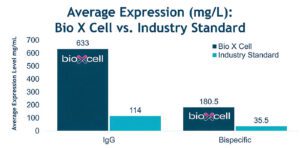
When expression workflows are properly optimized across DNA mass ratios, transfection reagent formulations, culture media composition, and harvest timing, yields well above historical benchmarks are achievable across formats. Data from this platform demonstrate conventional murine IgG production averaging 633 mg/L, compared to previously published transient murine expression examples averaging approximately 114 mg/L, a more than five-fold improvement. For murine bispecific formats, the same platform averaged 180.5 mg/L versus previously reported transient murine bispecific examples averaging 35.5 mg/L. The proportional improvement is comparable across both format classes. Gram-scale preclinical production is achievable even for the most structurally demanding formats without requiring stable cell line development.
Purity and endotoxin control
Yield at the expense of purity is not a viable tradeoff for in vivo applications. Recombinant antibodies intended for in vivo use must meet quality standards across multiple dimensions simultaneously: product-related impurities, including aggregates, fragments, and endotoxin, must be controlled within defined specifications at every lot.
Endotoxin is a particular concern for studies measuring immune activation, cytokine biology, or tumor microenvironment dynamics, where uncontrolled endotoxin burden can introduce signals that are indistinguishable from treatment effects. Endotoxin control is therefore not a release formality but a scientific requirement for study interpretability.
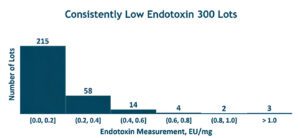
Across 300 released custom service lots spanning multiple antibody formats, endotoxin levels were consistently maintained within defined internal release specifications. Ninety-one percent of lots measured ≤0.4 EU/mg, well within the 0.5 EU/mg threshold commonly referenced for in vivo study readiness.4 That distribution reflects process consistency rather than occasional good performance: the same controlled purification conditions and quality checkpoints applied across every lot produce a predictable endotoxin outcome, independent of format or production scale.
Lot-to-lot consistency
Purity and endotoxin performance on a single lot are necessary but not sufficient for multi-cohort in vivo research. The question that governs longitudinal and multi-site study design is whether lot three will be analytically interchangeable with lot one. Lot-to-lot antibody variability is among the most common and most underappreciated contributors to irreproducible preclinical data, and it is a confounder that experimental design cannot correct for retrospectively.
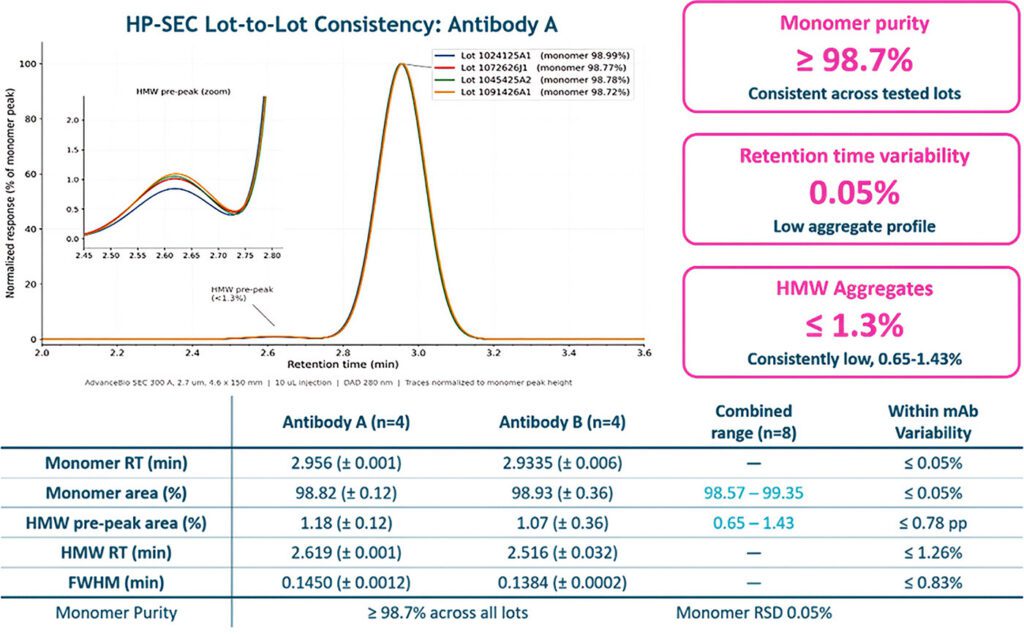
Treating lot-to-lot consistency as a built-in specification rather than a hoped-for outcome requires that the same analytical release package be applied to every lot, and that the production process be controlled tightly enough to make the results of that package predictable. High-performance SEC (HP-SEC) provides the most sensitive window into that consistency, resolving monomer from high-molecular-weight aggregate species and capturing subtle process drift through retention time and peak shape metrics.
HP-SEC data from four independently produced lots of two representative antibodies, MAR1-5A3-CP056 and 29F.1A12-CP005 (n=8 total), demonstrate what that consistency looks like in practice. Monomer purity exceeded 98.7% in every lot across both antibodies, with a combined range of 98.57 to 99.35% and within-antibody RSD of ≤0.05%. HMW pre-peak area remained ≤1.43% across all eight lots (range 0.65 to 1.43%), with within-antibody variability of ≤0.78 percentage points. Monomer retention time was stable within each antibody to ≤0.05% RSD, and peak width at half maximum, a sensitive indicator of column performance and process consistency, remained stable within each antibody across all lots. Together, these metrics demonstrate that the production and analytical processes are sufficiently controlled to deliver interchangeable lots across independent production runs.
Translating analytical requirements
Treating antibody reagent quality as a study design variable, rather than a procurement decision, changes how specifications should be set before work begins. For endotoxin, the relevant question is not whether a lot passes a generic release threshold but whether that threshold is appropriate for the biology being measured. Studies interrogating immune activation, cytokine signaling, or tumor microenvironment dynamics require more stringent endotoxin limits than studies where immune readouts are not the primary endpoint; the specification should follow the assay, not the other way around.
For lot-to-lot consistency, the practical requirement is that the same analytical release package, minimally, SEC purity profile, monomer retention time, and HMW aggregate content, be obtained for every lot used in a study, and that acceptable ranges be pre-specified rather than assessed retrospectively. When those ranges are defined in advance, an out-of-specification lot can be identified before animals are dosed rather than after results are in hand.
Yield determines whether these specifications are enforceable at the scale a study actually requires. A consistency specification that cannot be met at the multi-gram scale is not a specification; it is an estimate. The data presented here illustrate that strong yield is achievable for both conventional and bispecific formats, while analytical consistency can be maintained across independent recombinant antibody lots. For researchers designing studies where the antibody must behave the same way every time, that combination is the starting point for a defensible experimental design.
References
- Chen S, et al. Immunoglobulin gamma-like therapeutic bispecific antibody formats for tumor therapy. J Immunol Res. 2019 Feb 11; 2019:4516041. doi:10.1155/2019/4516041.
- Wei H, et al. Structural basis of a novel heterodimeric Fc for bispecific antibody production. Oncotarget. 2017 May 2;8(31):51037-51049. doi: 10.18632/oncotarget.17558.
- Schaefer W, et al. Immunoglobulin domain crossover as a generic approach for the production of bispecific IgG antibodies. Proc Natl Acad Sci USA. 2011;108(27):11187–11192. doi:10.1073/pnas.1019002108.
- Malyala P, Singh M. Endotoxin limits in formulations for preclinical research. J Pharm Sci. 2008;97(6):2041–2044. doi: 10.1002/jps.21152.
Christina Bouwens is a marketing manager at Bio X Cell.


