
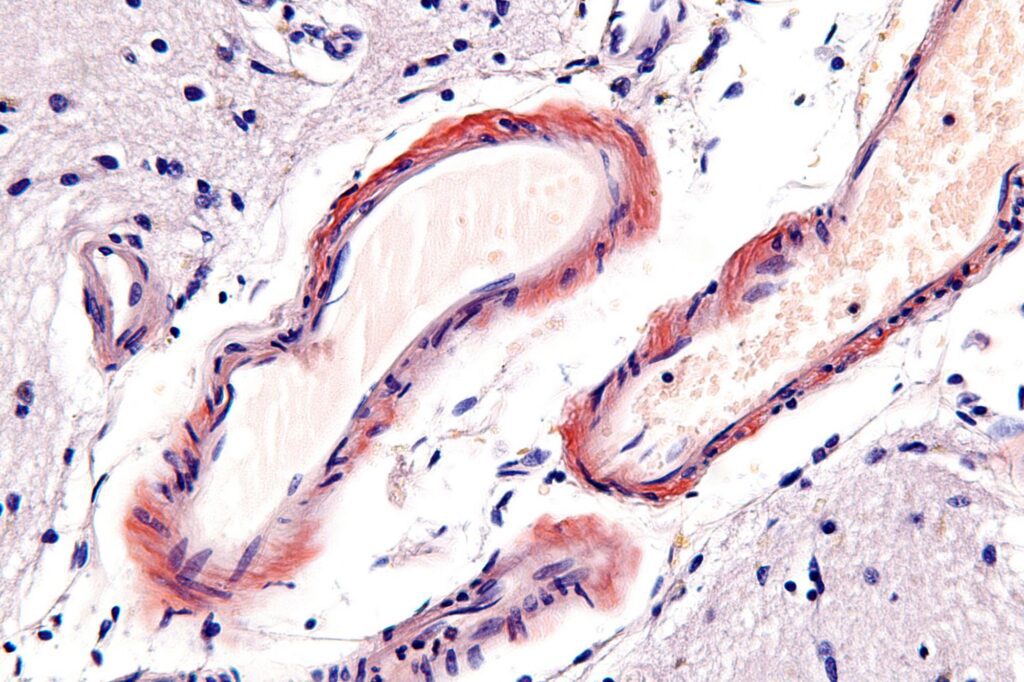
A professor of pharmaceutical and biomedical sciences at the University of Rhode Island’s (URI) College of Pharmacy received a $1.5 million grant to research cerebral amyloid angiopathy (CAA), a disease prevalent in the elderly population and commonly found in patients with Alzheimer’s disease.
CAA is characterized by the abnormal buildup of amyloid-beta protein in the walls of the brain’s blood vessels. Over time, vascular amyloid accumulation can damage and ultimately weaken the vessels, increasing a person’s risk for brain bleeds, hemorrhagic stroke, and contributing to cognitive decline. The condition is difficult to accurately diagnose and lacks targeted treatment options.
“Despite the prevalence of the disease, there are no reliable early-stage biomarkers, and disease-modifying therapies currently do not exist,” said William Van Nostrand, PhD, co-executive director of the George & Anne Ryan Institute for Neuroscience at URI.
The grant is part of a $9 million five-year Transatlantic Networks of Excellence grant from the Leducq Foundation. The initiative is known as TRAFFIC (Translational Framework For Innovation in Cerebral Amyloid Angiopathy).
The goals of the TRAFFIC study are to find and clarify disease mechanisms, identify early-stage biomarkers, and reveal potential targets for disease intervention.
“Our role at URI will be to perform studies to address why CAA develops in people and how certain risk factors for disease can increase the chance for bleeding in the brain,” explained Van Nostrand. “This will be done using an animal model developed here at URI that mimics CAA found in humans.”
The project will begin in January 2027, and Van Nostrand will collaborate with scientists from Harvard Medical School, Vanderbilt University Medical Center, Vall d’Hebron Research Institute (Spain), and Otto von Guericke University Magdeburg (Germany).
Since 2024, Van Nostrand has been working on another project funded by the Leducq Foundation that focuses on the disruption of brain waste clearance mechanisms that contribute to the biological processes by which CAA develops.
“Support from these highly competitive and prestigious transatlantic networks will reveal new insights into the disease, paving the way for better diagnosis and development of disease-modifying therapies,” said Van Nostrand.