
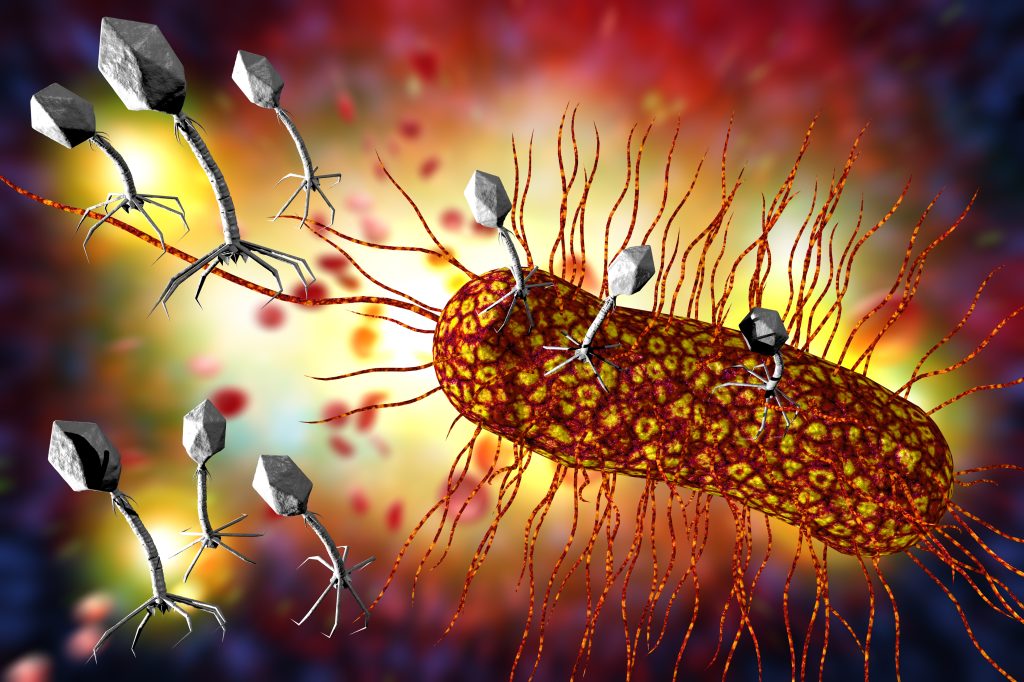
Researchers at Virginia Tech have developed a prophylactic phage therapy approach to protecting against potential future infections by pathogenic gut bacteria. Bacteriophages, or phages, are viruses of bacteria and do not infect humans or animals. Headed by associate professor and Blackwood Junior Faculty Fellow Bryan Hsu, PhD, the team engineered a nonpathogenic Escherichia coli bacterium that produces a phage targeting the enteric pathogen Salmonella enterica Typhimurium (STm).
Tests in mouse models of STm-induced colitis showed that the prophage-encoding bacterium colonized the gut, produced high levels of lytic phage and protected mice from subsequent oral salmonella infection, improving survival. The team believes their results represent a step toward the development of new weapons against different diseases.
“Eventually, in the future, this could be used to treat other diseases,” said Rogerio A. Bataglioli, PhD, a postdoctoral fellow in the Department of Biological Sciences. “It’s not about replacing antibiotics but having one more option on the shelf to fight infections.”
Hsu is senior and co-corresponding author, and Bataglioli first and co-corresponding author of the researchers’ published paper in Nature Microbiology, titled “Prophage-encoding engineered bacteria enable prophylactic lytic phage therapy for enteric infection in mice.” In their paper the authors wrote, “In this study, we show that a nonpathogenic E. coli gut bacterium can be engineered to produce an obligately lytic antipathogen phage, and the application of this lyto-lysogen before oral STm infection can improve survival in mouse models and reduce intestinal colonization of the pathogen.”
The mammalian gut microbiome is teeming with a delicate balance of bacteria and the bacteriophage viruses that keep them in check phages. Each bacterial species usually has its own set of phage partners.
When bad bacteria enter the gut microbiome ecosystem there are typically no phages present, allowing the bacteria to cause mayhem. By the time the host is sick, it is too late for phages, and they’ll simply reach a balance with the bad bacteria. Hsu said phage therapy, the use of phages to treat bacterial infections, is particularly hard to make successful for treating intestinal pathogens. “Phage therapy is a promising antibacterial approach but it has limited efficacy against enteric bacterial infections, such as Salmonella enterica Typhimurium (STm),” the authors wrote in their paper.
![(From left) Roger Bataglioli and Hiba Baaziz in the lab. [Photo by Felicia Spencer for Virginia Tech.]](https://www.genengnews.com/wp-content/uploads/2026/09/Low-Res_image-3-300x152.jpg)
“It’s challenging, especially in the gut, because phages and bacteria tend to coexist for long periods of time,” said Hsu, an affiliate with Fralin Life Sciences Institute’s Center for Emerging, Zoonotic, Arthropod-borne Pathogens.
This coexistence makes establishing the high phage-to-bacteria ratio needed to treat intestinal infections hard to achieve. “That’s extremely challenging to achieve in your gut,” Hsu said. “And then once you have a bacterial infection in your gut, a lot of times it’s just not even accessible to phages. It’s already hidden away in the mucosa or cells of your body; it’s not just free flowing to where the phages would be able to access them.”
But what if the phages in the gut could prepare for the orally ingested pathogen and strike it down as it enters the gut, negating the need for a battle? “… We hypothesized that establishing high concentrations of a pathogen-targeting phage in the gut before infection would prophylactically protect against future infection,” the team further wrote.
For their study they engineered a nonpathogenic E. coli bacterium to encode a prophage that produces lytic phages that only infect the target STm bacterium. Usually, this type of Salmonella phage remains dormant in the Salmonella bacterial genome, but Hsu’s team made several genetic modifications so that the phage is carried by E. coli. Once released into the gut, the phage targets and kills the Salmonella by lysis. This process rapidly increases the number of phages to fight the bacteria. The researchers coined this new type of phage-bacterial combination a “lytic phage-producing lysogen,” or “lyto-lysogen.”
Salmonella can typically detect phage DNA produced by non-Salmonella bacteria and prevent it from replicating. But in this case, the researchers were able to disguise the phage. “We were able to trick the Salmonella bacteria into thinking the phage from E. coli was ‘not foreign’ by adding a Salmonella gene into the E. coli genome,” Bataglioli said. “A phage that comes from our E. coli can infect Salmonella, can propagate easily in Salmonella, lyse it, and then all the phages that are produced from Salmonella can just keep replicating.”
This rapid reproduction eventually leads to the eradication of the infection from the gut. “What happens is that this good bacteria, the E. coli, produces all this antipathogen phage, and there is now a protective lining so that when Salmonella comes in, just after passing through the stomach and at its weakest point, it meets this high, killer density of phages,” Hsu said. In their paper the authors further noted, “Within the context of the mouse model of STm infection that we use here, we found that this prophylactic application of prophage therapy was superior to its therapeutic application post infection, and superior to the prophylactic or therapeutic application of free phage.”
The researchers say they targeted Salmonella because the pathogen has high global disease burden, and can be deadly in the elderly, children, and those with HIV. The bacterium also has a high prevalence of antibiotic resistance, and has been upgraded to a high-priority pathogen by the Centers for Disease Control and Prevention.
The researchers believe their work also has strong implications for other illnesses. “We’re starting off with Salmonella, but expanding, obviously, with the correct adaptations to target other diseases; other bacterial pathogens, would be an interesting route to explore,” Bataglioli said. The team further noted, “Collectively, our work shows that the lyto-lysogen strategy is a feasible prophylactic approach and represents an advancement in how phage therapy is conventionally conceived.” Hsu added, “We have a framework in place that shows that we could potentially put other phages in there and target other bacteria.”
Bataglioli plans to continue his bacteriophage research with the School of Chemical Engineering at the State University of Campinas in São Paulo, Brazil, in the fall.