

Sometimes, getting microbes to make more of a valuable compound requires genetic engineering, new nutrients, or a painstakingly redesigned fermentation process. Researchers in New Delhi have now shown that, for one medically important bacterium, part of the answer could be much simpler: change the color of the light.
Deepanshi Rajput, a doctoral student in biotechnology, and Kashyap Kumar Dubey, PhD, associate professor in the School of Biotechnology at Jawaharlal Nehru University in India, studied Streptomyces toxytricini, a filamentous soil bacterium that naturally produces lipstatin. Lipstatin is especially interesting because it is the natural precursor of orlistat, an anti-obesity drug that works by inhibiting enzymes involved in breaking down dietary fats.
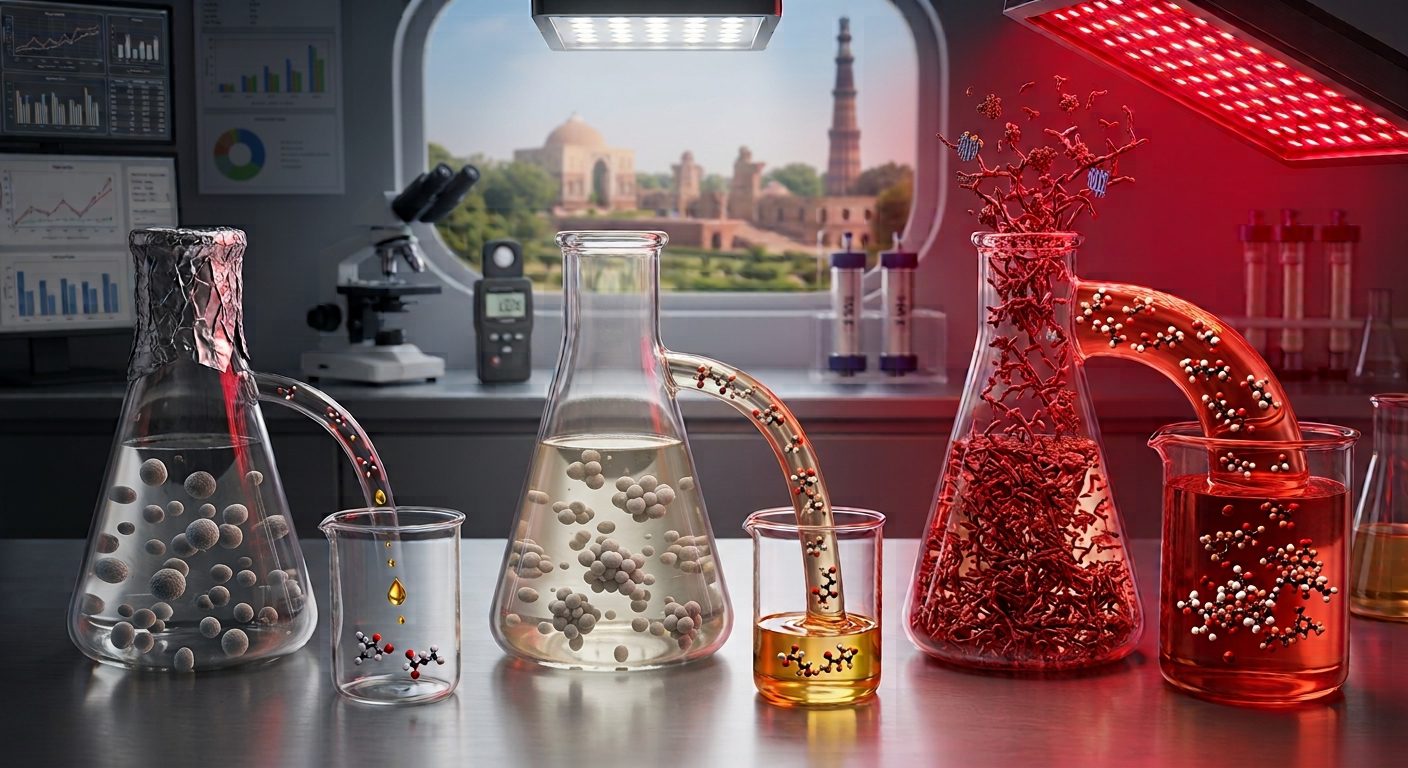
The team grew the bacterium under a spectrum of lighting conditions, including red, green, indigo, blue, yellow, violet, orange, and white light, with darkness serving as a control. What happened under red illumination stood out.
Lipstatin production reached roughly 6 g/L under red light, compared with about 1.2 g/L under white light and just 0.02 g/L in darkness. That translates to roughly a five-fold improvement over white light and about a 300-fold jump over the dark control.
Light was not merely changing how much of the compound the bacteria produced. It was also changing how they physically grew. Microscopy revealed that the bacteria formed dramatically smaller, looser structures under red illumination. Pellets averaged about 81 µm across, compared with roughly 333 µm under white light and 785 µm in darkness.
That architectural shift could matter in industrial fermentation. Dense clumps of filamentous bacteria can hinder the movement of nutrients and oxygen through a culture. Smaller, more dispersed structures might improve mass transfer and create conditions that favor production of secondary metabolites, such as lipstatin.
As the authors reported, their results show that “light acts as an important environmental factor” influencing both the morphology and metabolism of S. toxytricini. A search of the bacterium’s proteins also uncovered two putative bacteriophytochromes—possible red-light-sensing proteins that could help explain how the organism detects illumination.
But the biological mechanism remains unresolved. The researchers stressed that “a direct causal link cannot be established” between the altered pellet structure and increased lipstatin production from the current experiments alone. Functional studies of the suspected photoreceptors, molecular profiling, and validation in larger bioreactors will be needed.
Still, the results suggest that fermentation facilities might eventually gain another surprisingly straightforward control dial. Rather than modifying the microbe itself, a manufacturer could potentially influence what it produces simply by illuminating the bacteria differently—a “useful, non-invasive parameter” that the researchers argued deserves further investigation.

