
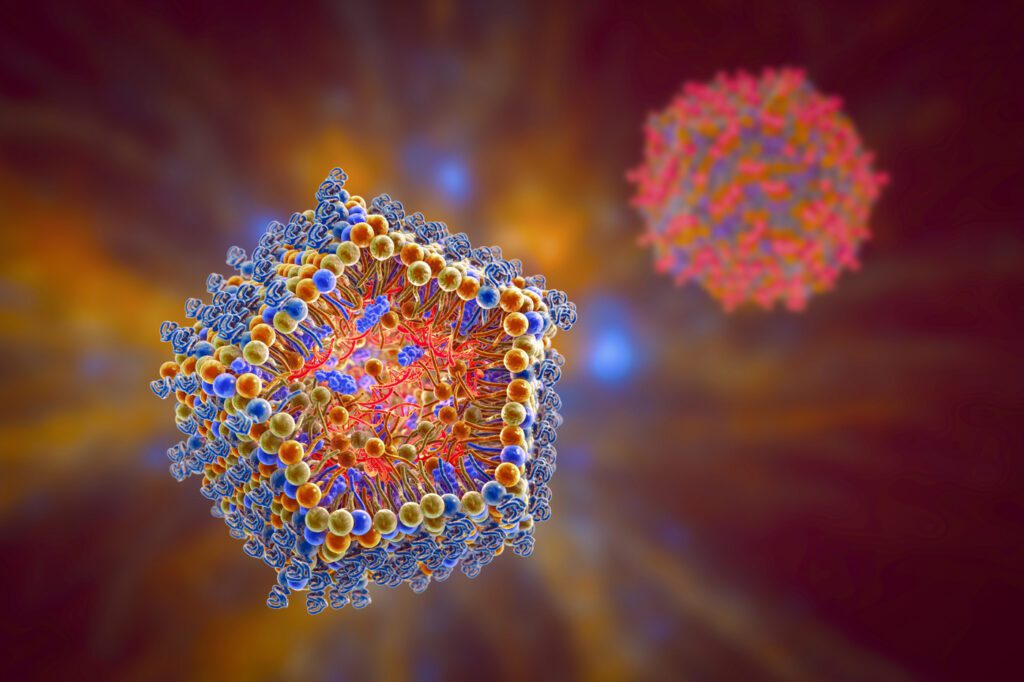
A new academic spin-off company aims to help manufacturers of lipid nanoparticles (LNP) produce products that are of consistent quality when produced at scale.
Bizon Labs, a spin-out of the Massachusetts Institute of Technology (MIT), is named after bison who run toward storms, as an indicator of how the company tackles head-on the challenges of improving LNP formulations.
According to Cedric Devos, PhD, a postdoctoral associate in the Department of Chemical Engineering at MIT, their work aims to physically optimize LNP delivery through adapting processes, rather than focusing on optimizing via chemistry alone.
“Our goal is specifically to reach a level of control over particle attributes that will enable novel biological applications,” he explains.
“One key example, often given in the field, is that you need extremely specific particle features to target specific organs, and these can’t be achieved yet with what’s out there in process work.”
The process innovations that the team behind Bizon have pioneered, Devos says, are in achieving control over LNP size and morphology that’s extremely difficult with conventional techniques.
This allows, he says, processes to be better understood and, thus, replicated at a variety of production scales.
To achieve this, the team split traditional mixing processes that produce LNPs in a single step into multiple steps to give better control over their attributes. For example, this allows them to tweak LNP shape to enable better product stability for long-term storage, he says.
In addition, he adds, breaking up the mixing process into multiple smaller steps allows companies to develop more complex models and simulations, which should, in turn, help them to understand their processes better.
But among the critical pillars they’re looking at for the future are optimizing the therapeutic cargo, better mechanistic understanding of the LNP process, and improving downstream processing, including purification.
“We’re still doing research,” he says. “There’s much more to control.”