Panelists:
Kevin Lance, PhD
Director, Product Management
Unchained Labs
- Time:
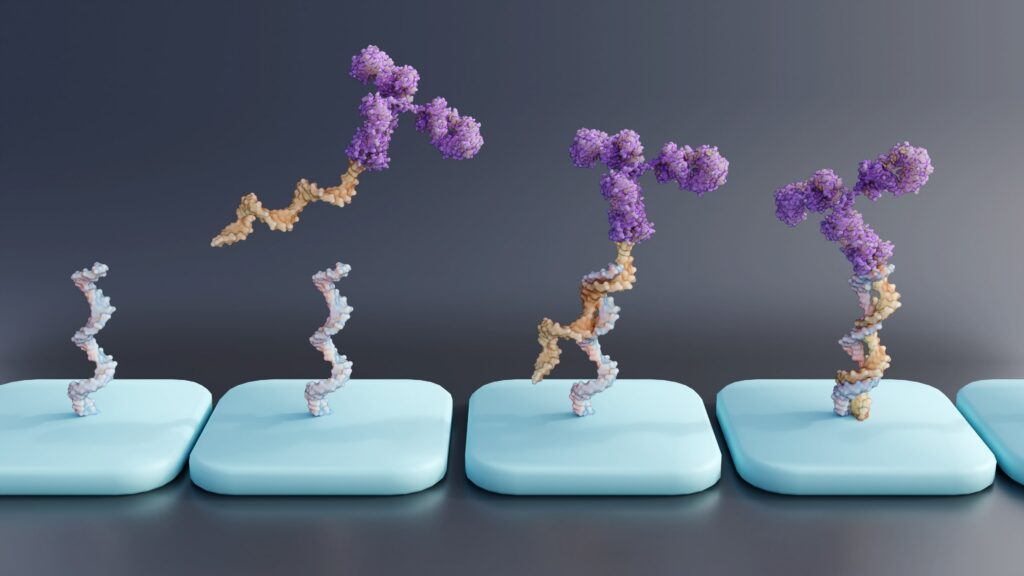
Oligonucleotide therapeutics, including ASOs, siRNAs, aptamers, and now antibody- and peptide-oligonucleotide conjugates (AOCs and POCs) are gaining momentum fast. But the chemical modifications and conjugations that make them work also make them harder to characterize than classic nucleic acids. Accurate quantification is the foundation of almost every assay and understanding how to arrive at the right concentration factor is the critical first step that echoes through every downstream decision.
This webinar follows oligo quantification from method development through conjugate characterization. We’ll cover what to consider when setting concentration factors and how UV/Vis extends to measuring conjugation ratio in AOCs and POCs.
We’ll also explore the boundaries of dynamic light scattering in oligo and nucleic acid formulation development. Oligos are flexible and sticky, which makes them hard to characterize by DLS. We’ll show what DLS can and can’t tell you across different lengths of nucleic acid constructs, up through mRNA.
Finally, we’ll look at viscosity data for oligonucleotides and nucleic acids to answer in-demand questions on high-concentration formulation and subcutaneous delivery.
Key learning objectives
- Understand the pieces that influence concentration factors for oligonucleotide quantification
- Extend UV/Vis quantification to AOC and POC characterization, including conjugation ratio
- Set realistic expectations for DLS in nucleotide and nucleic acid characterization
- Understand the relationships between viscosity, formulations, and nucleic acids
A live Q&A session will follow the presentation offering you a chance to pose questions to our expert panelist.
Produced with support from: