
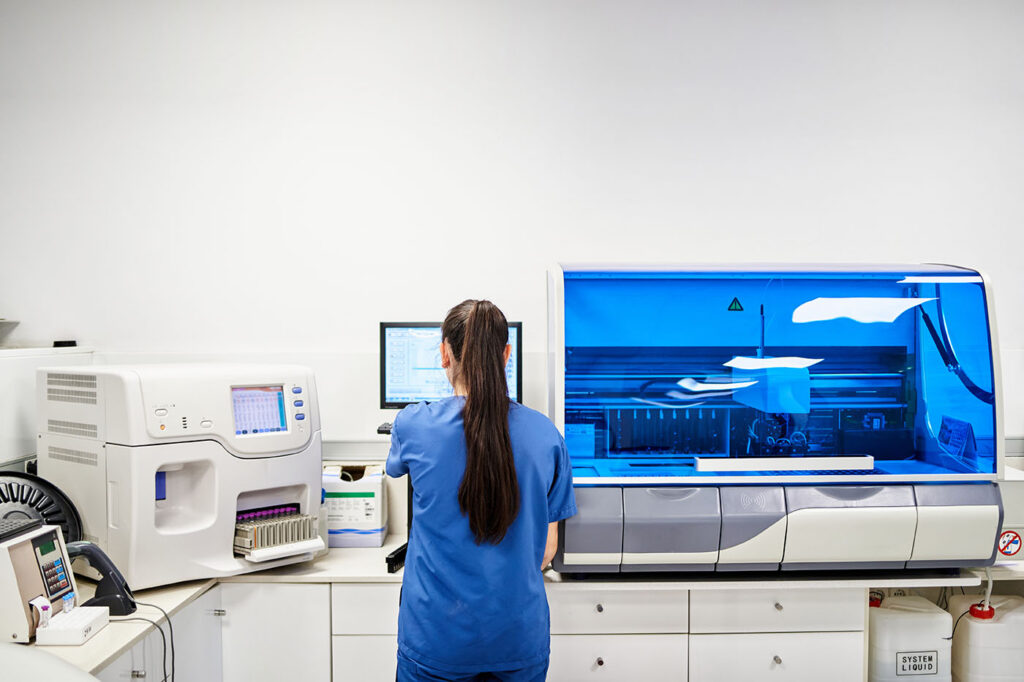
Like the cells they culture, bioreactors come in various shapes, sizes, and specialties. While they share basics like mixing, temperature control, monitoring, and inlets/outlets, the way they were designed and how they are used today represents a technological evolution. For example, the needs in agriculture vary from those in the biotechnology space or pharmaceutical industry just as much as the ideal conditions for growing HEK293 cells differ from iPSCs. Bioreactors have come a long way from clay pot fermenters to simple stir tanks to a sophisticated level of technology. Mixing techniques like a vertical wheel or rocking wave motion have been developed to help reduce shear stress on more delicate cell types. Automation and process control through Proportional-Integral-Derivative (PID) systems support quality, yield, and batch reproducibility. Single-use vessels improve manufacturing time as unit operations are overall reduced with the removal of cleaning and cross-contamination testing steps. And with milliliter to multiple liter scales available today upstream bioprocessing development and manufacturing can be efficiently streamlined.
When designing the first mini bioreactors engineers sought to provide small-scale versions of the liter(s) systems to allow for comparability, modeling, scalability, and early process development. Several systems now offer parallel reactors that can run up to 24 different conditions or more. This supports various applications including process parameter screening and early process development, operator training, media or strain or clone selection, biological replicates, comparability or robustness testing, and future personalized batches. Most bioprocesses, like cell culture or fermentation, benefit from Design of Experiment (DOE) optimization because it can model complex interactions using data from a fraction of the total possible test conditions run at the same time to maximize desired outcomes like yield and quality. For example, running parallel microbioreactors “improves both the time and cost efficiency involved in navigating the extensive parameters and complex combinatorial challenges of early microbial process development,” according to Sebastian Blum, marketing development manager at Beckman Coulter Life Sciences. Upstream parallelization also serves to reduce risks of large-scale batch loss in some cases when pooling the reactions together for downstream processing is appropriate.

To fully enable this outcome the mini bioreactor development needed to “integrate and miniaturize high-performance measurement and control functions into a compact footprint” according to Simon Wieninger, PhD, head of portfolio and applications at Eppendorf, who supports the DASBox® mini bioreactor system, one of the first small-scale reactors on market with a working volume of 60-250 mL. Wieninger highlights that the DASBox is not confined to a single application, noting that end users work on a mix of 2D or 3D cultures as well as traditional and advanced modalities like microbial fermentation, monoclonal antibodies (mAbs) or proteins, and cell and gene therapies. Although these are not the smallest reactor volumes possible or available, he comments that they are often sufficient for a personal batch. Conversely, the Vertical-Wheel bioreactors made by PBS Biotech differentiate themselves as cell culture-specific, which of course still covers a wide array of applications, and the BioLector XT microbioreactor from Beckman Coulter Life Sciences is for fermentation only.
Making it smaller
For Eppendorf, the miniaturization involved “developing MFC [mass flow controllers]-based gas mixing, miniature autoclavable sensors (like 4mm DO sensors), and innovative, liquid-free temperature control using Peltier-based heating, cooling, and exhaust gas condensers. Designing small-scale vessels, both glass and single-use vessels, that maintain fluidic properties for reliable scale-up and scale-down was also critical,” says Wieninger. With the complexity of biological reactions, Wieninger points out the use of “high-precision mini pumps with variable speed as well as wide-range controlled ultra-compact gas-mix submerse and head space” and their PID control design as a ‘snapshot’ of factors behind achieving high precision reactors.
The biggest challenge for the PBS-Mini series, available for 60-100 mL or 300-500 mL working volumes, was scaling down the Vertical-Wheel impeller itself in order to maintain the “characteristically low-shear and homogeneous fluid mixing obtained through the Vertical-Wheel ecosystem” per Sharon Harvey, director of product management and strategy at PBS Biotech who led the commercial launch of new PBS-MiniPRO™ bioprocessing system. “We had to match energy dissipation, oxygen transfer, and cell aggregate suspension at a fraction of the volume. For the MiniPRO this also meant integrating automation, perfusion control, and single-use sensors into a 24-position, small-scale, closed-system format without compromising sterility or usability.” She further highlights the risk mitigation benefit of pre-installed pH and DO spot sensors on the single-use vessels that avoids any cross-contamination when setting up experiments or moving cultures downstream.
Meanwhile, the BioLector XT microbioreactor leverages a plate-based or optional microfluidic chip approach to parallelization and customization based on the fermentation needs (aerobic, anaerobic, or microaerophilic). “Developing a module for anaerobic cultivation was unexpectedly challenging, particularly regarding usability in older BioLector models,” states Blum. He goes on to share “we’ve not only resolved this with the optimized gassing lid of the BioLector XT microbioreactor, but also now offer the capability for both feeding and pH control under strictly anaerobic conditions” and notes that with the 32 or 48 options this is a first for high-throughput anaerobic reactions without sacrificing pH control currently being leveraged in the (growing) microbiome research space. The airtight gassing lid provides constant nitrogen during microbial growth to maintain strictly anaerobic conditions or can be operated with an oxygen inlet for aerobes. Another key feature of this microbioreactor is the ability to measure biomass online and non-invasively using scattered light. “We considered this parameter to be so critical that, for example, we opted against individual temperature control in each cultivation well in favor of online biomass measurement, viewing it as a highly important process parameter,” comments Blum. He also notes that this is one of the reasons (mammalian) cell culture should be done on other bioreactors, such as the Cydem VT system.
Personalized approaches
Leaders in bioprocessing agree that small-scale bioreactors can serve to further personalized medicine efforts. Wieninger believes that “new advanced modalities (cell and gene therapies, or CGT) come with significantly higher production but also amazing patient value, therefore scale-out is essential to minimize production risk.” The DASbox’s modular design allows customization for personalized medicine, “such as testing patient-specific cell lines or optimizing protocols for individualized therapies. The small working volumes and flexible vessel options support tailored experimental setups on each vessel, even in a parallel setup.”
Likewise, because the MiniPRO allows for independently controlled cultures, this “enables patient-specific lines, engineered variants, or individualized media strategies to be evaluated side by side. This helps define process windows for each genotype and reveals patient-to-patient variability early,” states Harvey. She also notes the Mini and MiniPRO as GMP equipment, with 12 CFR part 11 compliant software, are capable of “supporting both development and decentralized manufacturing concepts” in the context of the future of personalized medicine.
Research into the effects of microbiomes on cancer prognosis and treatments can be expedited while maintaining the complexity of a microbiome within a single well, points out Maria Savino, PhD, MBA, global segment development manager of biomanufacturing at Beckman Coulter Life Sciences, on the importance of high-throughput microfermentation. With gut microbiomes being symbiotic to individual health, there are active development possibilities in targeting these microbes for improved patient care in the future of cancer treatments.1
Future advances
With all the advances available today, the engineers behind these reactors continue to innovate and integrate, filling market needs as the research leads them. They look to further automate, increase throughput, and provide new sensors depending on what the biology needs. Advancing real-time analytics will support both development and manufacturing timelines. As recently covered by GEN,2 the use of artificial intelligence (AI) for automated decision-making will soon be a reality. As Harvey puts it, “Microbioreactors will increasingly serve not only as development tools but as small-scale manufacturing units capable of producing patient-specific or exploratory batches under tightly controlled conditions.”
References
- Fernandez E, Wargo JA, Helmink BA. The Microbiome and Cancer: A Translational Science Review. JAMA. 2025;333(24):2188-2196. doi:10.1001/jama.2025.2191
- Dutton G. Process Monitors and Controls Shift Towards Unified Platforms. GEN – Genetic Engineering and Biotechnology News. Published September 15, 2025. Accessed January 12, 2026.