

Researchers from South Korea are developing a digital twin that combines mechanistic modeling with artificial intelligence. They hope the model will eventually allow them to create a fully autonomous lab, capable of operating with minimal human intervention at academic and on larger scales.
“We’ve been focused on combining this mechanistic model with the data-driven AI model to create a hybridized model,” explains Dong-Yup Lee, PhD, professor and head of the Bioprocess Digital Twin Lab at Sungkyunkwan University.
According to Lee, their digital twin differs from a conventional simulator or standalone model because it’s continuously connected to a multi-sensory modeling system, which collects relevant data from the bioreactor in their lab. The team, he says, has developed mathematical models of mammalian Chinese Hamster Ovary (CHO) cells and uses them to make predictions about how the cells will behave under different bioreactor conditions.
However, he says, predictions from the mechanistic model alone do not always achieve the accuracy or adaptability required for real-time operation. As such, the team has incorporated data-driven AI as a complement to provide more adaptive control of the bioreactor.
“One of the limitations of AI is, if you have lots of data, it’s good for prediction, but it can’t explain why,” he says. “So, we use what is called explainable (XAI).”
XAI can provide information about what input conditions are most strongly affecting process outputs, he says, rather than just providing a prediction. This added interpretability can provide multiple options for improving and controlling bioprocess performance.
According to Lee, the biggest challenge for the team so far has been integrating the mechanistic model with XAI in a way that connects data collection, prediction, and forecasting directly with process control.
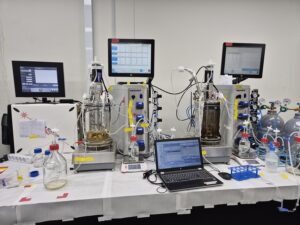
“We’re probably at 80% on [developing] the hybridized model,” he says. “The remaining 20% is working out how these models can be linked to and interact with the control system and our future robotics.”
Bringing these aspects together, he says, will be a key focus of the team’s future research, with the ultimate aim of moving beyond predictive digital twins toward increasingly autonomous process operation.
Lee is open to industry collaborations, particularly around digital twins, advanced bioprocess monitoring, and autonomous biomanufacturing.