

The emergence of increasingly complex biologics such as multi‑specific antibodies, cytokines, fusion proteins, and other structurally demanding modalities has exposed the limits of conventional bioprocessing. Many of these molecules are difficult to express at commercially viable yields, and their quality attributes can be highly sensitive to the cellular environment. As a result, productivity, consistency, and cost remain major constraints across the industry.
Traditional cell line development (CLD) relies on constitutive promoters that drive static expression throughout development and production. Because production is always on, cells must divide and manufacture protein simultaneously, even when the product is burdensome or toxic. While this model worked relatively well for easy-to-express monoclonal antibodies, it does not work well for next-generation biologics, where the inherent trade-off between higher specific productivity and rapid cell growth, both competing for the same cellular resources, is increased. Light‑controlled gene expression using optogenetics is emerging as a credible alternative.
This article explores the ten most important questions facing optogenetic biomanufacturing as it moves from proof‑of‑concept demonstrations toward mainstream adoption in modern bioprocessing.
1. What is optogenetics, and why is it relevant to biologics manufacturing?
Optogenetics uses light‑responsive proteins to control specific cellular functions. In biomanufacturing, the key application is regulating gene expression with light instead of relying on constitutive promoters or chemical inducers. When light‑controlled gene expression systems are engineered into production cell lines, illumination at defined wavelengths can switch expression on, off, or to intermediate levels.
This is important because it introduces a fundamentally different control modality. Conventional systems provide static expression, whereas optogenetics enables dynamic, reversible, and tunable control. As biologics become more complex and more sensitive to expression conditions, having a way to precisely modulate transcription directly, rather than perturbing the entire cell by modulating process parameters such as temperature, will become increasingly valuable.
2. What core limitation in biologics manufacturing does light‑based control address?
The main limitation is the inherent competition between cell growth and protein production. In constitutive systems, cells must divide and manufacture protein at the same time, drawing on the same finite pool of metabolic resources. This creates a structural trade‑off: clones that produce strongly have a slow doubling time and/or do not grow to viable densities, while clones that grow well often produce only modest titers. This trade‑off becomes much more pronounced for challenging molecules such as multi‑specific antibodies, cytokines, and fusion proteins that are aggregation‑prone or place a significant burden on the host cell.
Optogenetics addresses this by separating the growth and production phases. Cells can grow in an uninduced, low-burden state and then transition into a productive state upon illumination. As light acts directly on transcriptional regulators in a dose-dependent manner, expression can be tuned precisely rather than modulated indirectly through temperature shifts or coarsely and irreversibly by chemical induction. Chemical inducers can also negatively affect cell performance through off-target effects and are difficult to remove during downstream processing, which has limited their adoption in mammalian biomanufacturing. The direct, tunable control by light also enables more deliberate modulation of pathways that influence critical quality attributes such as post-translational modifications (PTMs), which is increasingly important for complex biologics and biosimilars.
3. How does optogenetic light exposure work, and is it safe for cells and media?
Optogenetics uses light as an informational cue rather than an energy source. Because photoreceptors respond to brief, low-intensity pulses and stay “on” for a tunable period of time before reverting to the off state, optogenetic systems can maintain precise control without continuous or high-power illumination.
The wavelengths used in bioprocessing are in the visible range and non-ionizing, operating well under established phototoxicity thresholds. At these levels, light does not harm cells or DNA, nor does it disrupt cellular physiology. Although certain media components are known to be light-sensitive, the illumination used for optogenetic induction has not shown detrimental effects on cellular performance.
4. What is the impact of optogenetics on lab operations?
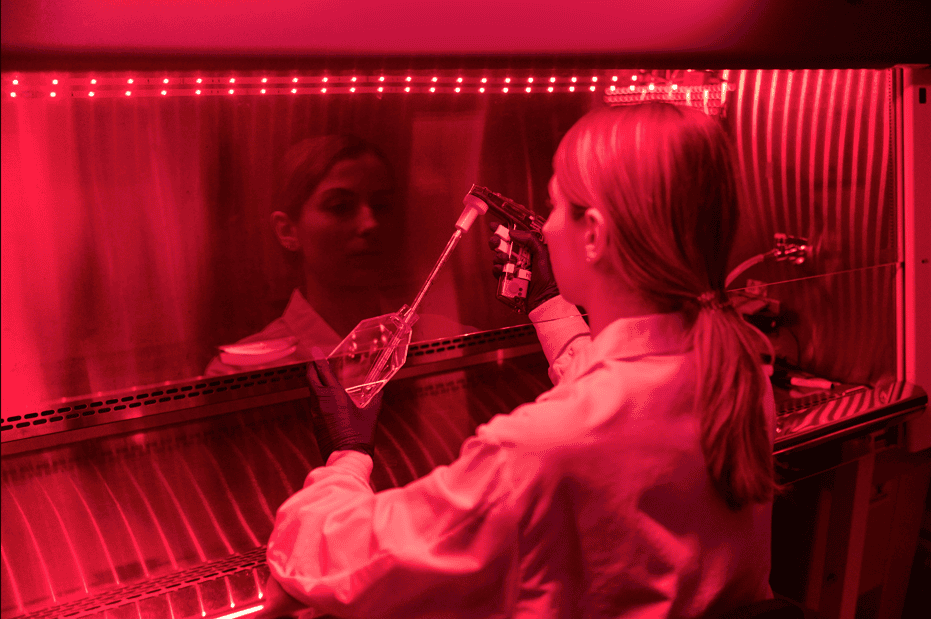
Optogenetic workflows use standard lab equipment with the addition of illumination devices compatible with existing infrastructure, such as plates, shake flasks, or bioreactors. The main operational difference occurs during pool generation and single-cell cloning, where cells must remain uninduced. This is achieved by working under “safe light” conditions, visible wavelengths that do not activate the specific optogenetic system but allow the operator to handle the cell culture. Only small areas of the lab need to be adapted for this purpose. For all other operations, including biomanufacturing, local interventions to shield cells from room light are typically sufficient.
5. How many cellular functions can be controlled with light in a single cell line?
Current systems can independently regulate cellular functions using two or three different wavelengths. For example, one color may control production while another modulates a critical quality‑related pathway. Functions that require coordinated timing can be linked to the same wavelength. As genetic circuit design advances, the number of independently controllable functions is expected to increase.
6. When might optogenetically manufactured biologics reach clinical and commercial stages?
Optogenetic cell line development is already being explored for multiple programs. Regulatory agencies have established pathways for evaluating emerging bioprocess technologies, and optogenetic systems are beginning to move through these mechanisms. If early development proceeds as expected, optogenetically controlled processes could support clinical filings in the next two years, with commercial adoption following thereafter.
7. Can optogenetics be integrated into existing facilities?
Yes. Optogenetic manufacturing does not require new bioreactor designs; illumination hardware can be added to standard single‑use or stainless‑steel systems. For single‑use bags, light is delivered externally through the bag without breaching the sterility barrier; for stainless‑steel tanks, cultures can be circulated through illuminated loops. No cleanroom redesign is required.
8. How does optogenetic manufacturing scale to larger bioreactors?
Scaling optogenetic systems depends on three factors: the sensitivity of the photoreceptors, the lifetime of their activated state in the dark, and the mixing and light-scattering characteristics of the bioreactor. Modern optogenetic systems for biomanufacturing are designed to respond to very low light intensities, and once activated, they gradually return to the off state in the dark at a characteristic rate, typically over tens of minutes.
Since stirred-tank bioreactors mix continuously and scatter light throughout the vessel, cells receive sufficient illumination over the photoreceptor’s characteristic activation lifetime even at large volumes. Simulation studies and early pilot-scale experiments up to the 200 L scale suggest that optogenetic activation can be achieved at commercially relevant scales, including stainless steel and single-use systems.
9. What has convinced established players to evaluate this technology?
Biologics development and manufacturing are intentionally conservative, with new technologies adopted only when they demonstrate clear, reproducible benefits and maintain patient safety. For any emerging bioprocess platform, the threshold for evaluation is data showing that it can deliver meaningful improvements without introducing new risks or operational complexity.
In comparative studies, optogenetic induction has produced more than two‑fold increases in titer for standard monoclonal antibodies as well as for more difficult‑to‑express therapeutic proteins. These gains have been achieved while maintaining or improving critical quality attributes, including those influenced by folding, assembly, and post‑translational modification.
As the next generation of therapeutics become increasingly complex, leading biopharma and CDMO players see the need for novel biomanufacturing platforms capable of meeting that complexity without compromising titers, and for that reason several key players are actively evaluating optogenetic technology for potential integration.
10. Where is optogenetic biomanufacturing headed in the next decade?
If current trends continue, optogenetic control may become a standard tool for managing expression, quality, and other cellular functions in biologics manufacturing. The ability to modulate gene expression dynamically opens possibilities for more efficient production of complex therapeutics, more predictable quality profiles, and more flexible facility design. As the technology matures, it is likely to be adopted across CDMOs, biotech, and biopharma companies seeking greater control over their manufacturing processes.
Maximilian Hoerner, PhD, is the head of optogenetics at Prolific Machines