
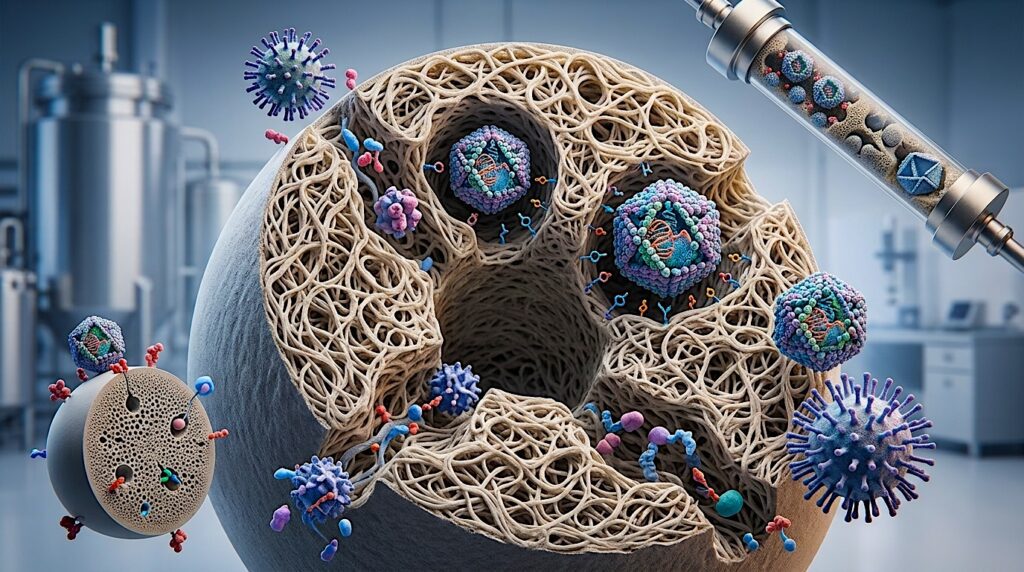
The rapid expansion of viral vectors, vaccines, and other complex biologics is creating a familiar downstream-processing problem in a new form: the molecules and particles that manufacturers need to purify are getting bigger. JNC is addressing that challenge at BioProcess International 2026, where the company is showcasing its Cellufine chromatography portfolio alongside monolith-like particle (MLP) products currently under development.
Cellufine is JNC’s family of cellulose-based chromatography media for biopharmaceutical purification. The company’s newer MLP platform takes that foundation in a different direction by using a large-pore bead architecture intended to improve access for bulky biological targets that can be difficult to accommodate with conventional porous media.
That design was the focus of a presentation by Chigusa Mori, R&D scientist at JNC, titled “Cellufine MLP: Wide Pore Cellulose Base Bead 3D Architecture for Large Biomolecule Chromatography Applications.”
JNC is also highlighting two development-stage MLP products through poster presentations. One examines Cellufine MLP DexQ for separating empty and full adeno-associated virus (AAV) particles, which is a persistent purification challenge in AAV manufacturing. Another explores Cellufine MLP DexS for viral-vector purification.
MLP DexS uses dextran sulfate as a ligand and is being investigated for large-particle applications, including vaccines. Data reported by JNC show that the resin concentrated inactivated influenza virus 13-fold while cutting protein impurities by 90.3%. In testing with human coronavirus OC43, JNC reported a 97.3% reduction in protein impurities together with 91% virus recovery. Those results point to the broader bioprocessing question behind JNC’s showcase: how chromatography can evolve as therapeutic modalities move beyond traditional proteins toward particles and assemblies with very different physical properties.
For downstream developers, pore architecture is becoming more than a resin-design detail. It can determine how effectively large targets enter the bead, interact with ligands, and ultimately separate from process-related impurities.
By bringing its MLP technology to BPI26, JNC is positioning large-pore cellulose chromatography as one approach to extending conventional column purification into areas where the size of the product itself increasingly shapes process performance.