
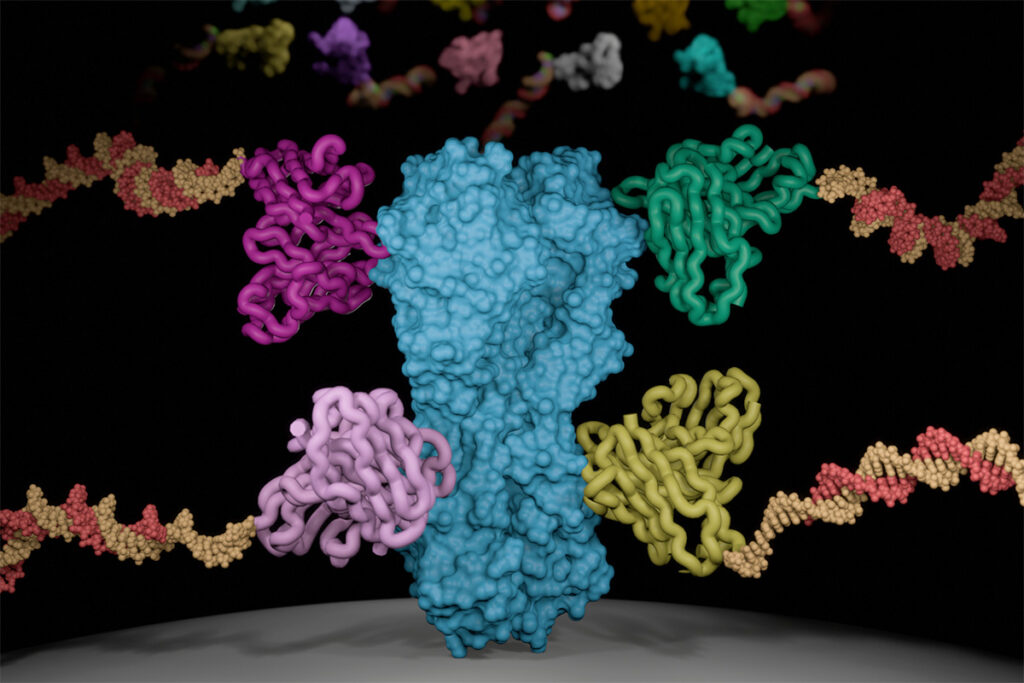
For decades, antibodies have been one of the crown jewels of modern medicine—powerful molecules that can neutralize viruses, tame autoimmune diseases, and revolutionize cancer care. Yet despite their promise, actually synthesizing and studying them has been one of the most stubborn bottlenecks in antibody discovery.
Characterizing antibodies has traditionally required painstaking, one-by-one synthesis and testing, a process that can take weeks to months for a single candidate. With trillions of potential antibody combinations in the human body, this slow pace has left researchers searching for a scalable solution.
Now, scientists at the University of Illinois Urbana-Champaign have unveiled a new platform, called oPool+ display, that can rapidly build and test hundreds of antibodies in parallel. The study titled, “High-throughput synthesis and specificity characterization of natively paired influenza hemagglutinin antibodies with oPool+ display,” was published in Science Translational Medicine and describes how the method can shrink weeks or months of benchwork into just a few days, while cutting costs.
“In a research lab, each antibody can take one person weeks to months to produce and analyze. So we asked, how can we scale this up in a way that lets us really understand this extremely diverse class of molecules?” said first author Wenhao “Owen” Ouyang, a graduate student in biochemistry. “Instead of analyzing one antibody at a time, this approach let us evaluate thousands of antibody–antigen interactions in just a few days.”
How oPool+ display works
The platform merges two powerful approaches: oligo pool synthesis and mRNA display. Together, these tools allowed the scientists to synthesize large libraries of antibodies and directly screen their binding properties against panels of variants.
“As a proof of concept, we applied oPool+ display to probe the binding specificity of more than 300 uncommon influenza hemagglutinin-specific antibodies against nine hemagglutinin variants through 16 screens. More than 5,000 binding tests were performed in three to five days of hands-on time with further scaling potential. Follow-up structural and functional analysis of two antibodies revealed the versatility of the human immunoglobulin gene segment D3-3 (IGHD-3-3) in recognizing the hemagglutinin stem,” wrote the authors
By mapping these interactions, the researchers could identify shared features across antibodies from different individuals—an insight that could help explain why some immune responses are broadly protective. “This is one of the key research areas for influenza vaccination research,” Ouyang noted, “because we would like to have a vaccine that works for everyone.” Finding common antibody features among different people is a big step toward that goal, he added.
Looking ahead
Beyond influenza, the researchers see broad applications for oPool+ display. They are already working to expand the platform from hundreds to thousands, or even tens of thousands, of antibodies. Such scale could potentially accelerate discovery across infectious diseases, cancer, and autoimmune disorders.
The technology may also serve as a critical testing ground for artificial intelligence models that predict antibody structures and binding profiles. “We could easily create an AI model that can make a lot of predictions,” Ouyang said. “But we don’t really have an idea of how accurate they are because we haven’t had any way to systematically validate the results. So we are excited about using AI to create predictions of antibodies and then validating them in real time with oPool+, and feeding the results back to the AI model to continually improve it.”
Over 150 different FDA-approved antibody therapeutics are being used in clinical settings to treat diseases from cancer to infectious diseases to autoimmune diseases. With a rapid, high-throughput method like ours, if we can search for a potential antibody candidate that’s really good against a certain disease, then it has great potential in becoming an effective therapeutic, said Ouyang.