
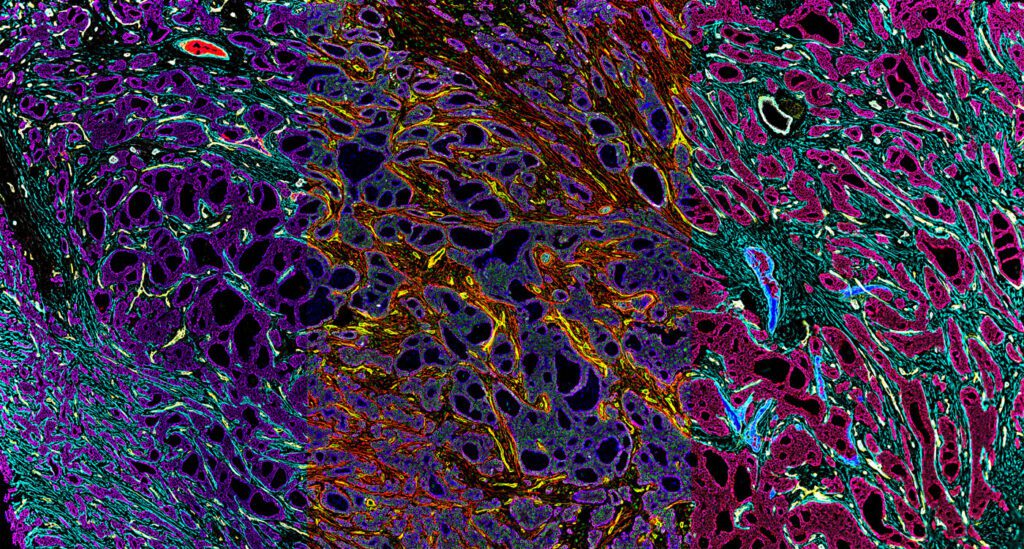
Assessing the state of spatial biology earlier this year, Alexander E. Kalyuzhny, PhD, of the University of Minnesota noted how spatial platforms facilitated a more advanced approach to precision medicine. They have already identified the exact expression of drug targets and neighboring cells affecting their activity; predicted clinical outcomes through topographical biomarkers revealing the proximity of immune cells to malignant clones; and enabled the development of uniquely tailored treatments for complex diseases that target specific regions.
But fully realizing the clinical potential of spatial biology, Kalyuzhny asserted, will require moving from isolated, single-lab experiments to industrialized, reproducible workflows. That process, he he wrote April 22 in the journal Cells, will require:
- Progressing from 2D slices to 3D volumetric reconstruction to capture the connectivity of neural networks and vascularized tissues.
- Adopting interoperable data standards and cloud-native analytical pipelines to manage the extensive datasets generated by whole-organism atlases.
- Standardizing reagent validation, particularly the rigorous calibration of antibodies in high-plex environments.
“The future of spatial biology will be shaped by a new research paradigm that integrates various fields and industries. This approach connects academic discoveries with scalable applications in real-world settings, such as hospitals and clinics,” Kalyuzhny predicted. “Establishing an open, collaborative environment for sharing resources and standardizing methods is crucial. This not only facilitates the participation of new researchers but also lays the foundation for a new biology.”
This new biology is not without its growing pains.
Most recently, over the past year, academic labs were forced to reduce spending due to the Trump administration cutting about $783 million in NIH grants (upheld by the U.S. Supreme Court last year) and attempting a 15% cap on indirect cost reimbursement (from which the administration retreated after not appealing a February appellate court ruling blocking the cap).
The fiscal and policy turmoil helps explain a sobering trend in this year’s updated edition of GEN’s spatial biology A-List, first published in 2021 and updated every year since: Revenues for four of the top five public companies in spatial biology dropped nearly four percent year-over-year, to approximately $3.269 billion between January 2025 and June of this year, from $3.398 billion between January 2024 and June 2025.
Total capital raised by the top five private companies, however, soared nearly 11% year-over-year to more than $708 million this year, from more than $640 million in 2025, which was an eight percent climb from $591 million-plus a year earlier.
That reflects growing investor interest in spatial biology—seen even more dramatically in the five of 10 “Up & Comers” companies that attracted financings during 2026 (from grants to traditional venture capital). These companies are not ranked, but warrant mention based not only on capital raises, but on collaborations, new products, attention in peer-reviewed publications, and other developments.
Public companies are ranked by their combined revenues for 2025 and the first half of 2026, as disclosed in regulatory filings, including sales of products or services, as well as revenue from collaborations and R&D activity. Private companies are ranked by the total capital they have raised, as disclosed by the companies themselves, either in press statements or in responses to GEN queries verifying figures compiled by other sources.
Companies that failed to respond at deadline have been ranked according to their most recently published figures for total capital raised.
Top 5 Public Companies
1. Bruker (BSI Nano segment, including Bruker Spatial Biology)
2025–26 Revenue: $507.3 million in Q1–Q2 2026; $1.084 billion in 2025
2024–25 Revenue: $508.7 million in Q1–Q2 2025; $1.098 billion in 2024
% Change: -1.0%
At the 2026 American Association for Cancer Research (AACR) Annual Meeting in April, Bruker Spatial Biology launched new cross‑platform workflows linking GeoMx® DSP to CellScape™ XR and CellScape XR to CosMx® SMI. The workflows are designed to reveal biological relationships incapable of being captured with a single modality alone. Bruker Spatial Biology also debuted new 208‑plex datasets from its CellScape™ XR, highlighting flexible subcellular proteomics for rapid, quantitative spatial phenotyping in oncology applications. In February, Bruker Spatial Biology launched CellScape XR, a next-generation spatial proteomics platform designed to advance the development of diagnostic and prognostic assays by enabling high-throughput, reproducible spatial proteomics at the scale and rigor required for translational and clinical applications.
2. 10x Genomics
2025–26 Revenue: $301.879 million in Q1–Q2 2026; $642.823 million in 2025
2024–25 Revenue: $327.791 million in Q1–Q2 2025; $610.785 million in 2024
% Change: +0.7%
10x Genomics has expanded into clinical diagnostics through collaborations with top-tier institutions announced throughout 2026. In July, 10x launched a collaboration with Switzerland’s Lausanne University Hospital (diagnostic applications of single-cell and spatial technologies for cancer care). A month earlier, 10x and Cleveland Clinic began a multi-year collaboration (novel diagnostics for bladder cancer). 10x in April launched its Atera in situ spatial biology platform, engineered to deliver whole-transcriptome spatial analysis with single-cell sensitivity at unprecedented scale. And in January, 10x unveiled clinical collaborations with Brigham and Women’s Hospital and Dana-Farber Cancer Institute, as well as the Cancer Research Institute.
3. Bio-Techne (Diagnostics and Spatial Biology Segment)1
2025–26 Revenue: $336.365 million (fiscal year ending June 30, 2026); $175.727 million (January–June 2025)
2024–25 Revenue: $346.263 million (fiscal year ending June 30, 2025); $178.188 million (January–June 2024)
% Change: -2.4%
Bio-Techne’s planned $11.3 billion acquisition by Merck KGaA, Darmstadt, Germany, announced June 25, is being challenged by a shareholder through the lawsuit Robert Garfield v. Baumgartner et al., filed September 9 in U.S. District Court for the Fourth Judicial District of Minnesota. The suit alleges that Bio-Techne’s proxy statement disclosing the transaction “misrepresented or omitted material information,” and seeks to stop a shareholder vote on the merger scheduled for September 23. Bio-Techne responded with a September 14 regulatory filing that denied wrongdoing, yet voluntarily provided supplemental information intended to avoid litigation costs and risks and allow the vote to proceed. Bio-Techne also disclosed that it had received multiple demand letters from other shareholders making similar claims about the proxy statement.
4. Standard BioTools
2025–26 Revenue: $41.250 in Q1–Q2 2026; $85.331 million in 2025
2024–25 Revenue: $41.984 million in Q1–Q2 2025; $174.432 million in 2024
% Change: -41.5%
Standard BioTools agreed in July to sell its mass cytometry business for up to $10 million to Multiplex Bio, whose founders and leaders include Michael Johnson, PhD, and Tom Villani, PhD, who pioneered the commercialization of spatial biology tools for global biopharmas as co-founders of Visikol, acquired by BICO in 2021. Standard BioTools agreed to provide Multiplex Bio with a working capital loan of up to $10 million at the closing of the transaction, expected by year’s end. In June, Standard entered into a reverse merger with drug developer Treeline Biosciences, creating a publicly traded combined company with more than $900 million in pro forma cash, which is expected to fund operations into 2029.
5, Quanterix (including Akoya Biosciences)
2025-26 Revenue: $24.705 million in Q1–Q2 2026; $69.2 million in 2025 1 2
2024-25 Revenue: Approximately $30 million in Q1–Q2 2025; $81.7 million in 2024 3
% Change: -15.9%
Quanterix in July showcased its Edison Award-winning PhenoCode Discovery™ IO60 Human Protein Panel as a new standard for spatial biology, delivering a comprehensive view of the tumor immune environment through 60 biomarkers analyzed simultaneously. In April, Quanterix joined PreludeDx® to announce that the companies’ AidaBREAST™ became the multi-omic assay to predict both locoregional recurrence risk and radiation therapy benefit in early-stage invasive breast cancer—a significant milestone in the clinical translation of spatial proteomics, according to the companies. AidaBREAST was developed by PreludeDx, which leveraged Quanterix’s Akoya PhenoImager® HT platform and Opal™ chemistry to obtain spatial multiplex protein expression that is integrated with targeted next-generation RNA sequencing for comprehensive assessment of tumor biology.
References
1. The figure for Q1-Q2 2026 consists of combined “product revenue” and “service and other revenue” disclosed for the “Spatial Biology” technology type in its Form 10-Q quarterly report for the second quarter, filed August 10 with the U.S. Securities and Exchange Commission.
2. The figure for 2025 was furnished by Quanterix and included in part $33.731 million in combined “product revenue” and “service and other revenue” disclosed for Spatial Biology in Quanterix’s Form 10-K annual report for 2025. However, Quanterix told GEN that the Form 10-K figure does not include revenue generated before the July 8, 2025, completion of its acquisition of Akoya, which issued approximately 7.8 million shares of its common stock and paid approximately $20 million in cash for Akoya.
3. The Q1–Q2 2025 figure of a year ago is derived from Quanterix, including approximately two quarters of performance from Akoya, when it lowered its 2025 revenue guidance in July to a range of $130 to $135 million, down from $140.0 million to $146.0 million, citing weakness in the U.S. academic and pharmaceutical end markets. The revised forecast included a “$30 million contribution from Spatial,” according to Quanterix’s second-quarter 2025 presentation to investors.
Top 5 Private Companies
1. Vizgen (includes Ultivue)
Total Capital Raised: More than $300 million
At the Human Cell Atlas (HCA) General Meeting in June, Vizgen debuted a 3D Volumetric Tissue Mapping dataset in neurodegenerative brain tissue using MERFISH 2.0™ chemistry on the MERSCOPE® Ultra Platform—capturing the three dimensions of thick tissue, preserving the spatial context lost by conventional spatial biology. In January, Vizgen completed a $48 million Series E financing led by ARCH Venture Partners and co-led by M Ventures and Northpond Ventures, with participation from existing investors. Proceeds are intended to develop Vizgen’s “roadmap” intended to unlock deeper biological insight through spatial multiomics, launched in February; expand the company’s ability to serve researchers globally; and scale manufacturing operations.
2. Resolve Biosciences
Total Capital Raised: “More than $100 million” 1
A paper published July 13 in Frontiers in Immunology cited Resolve Biosciences’ Molecular Cartography™ platform, which a research team from three German institutions applied in demonstrating the existence of mast cells in murine fibrotic livers and defined mast cell (MC) expression signatures, finding “significant correlations between liver fibrosis grade and the expression of several established MC markers.” Resolve’s website and LinkedIn feed in recent weeks promoted an available position for a computational biology scientist to join the company’s Assay Development team: “You will be responsible for the computational analysis of high-dimensional spatial single-cell data, with a strong focus on immuno-oncology and targeted gene panel design.”
3. RareCyte
Total Capital Raised: $125 million
RareCyte has expanded its Orion clinical-scale applications platform, launching two new Orion systems this year: Orion™ HT high-throughput spatial proteomics platform, designed for high-plex biomarker programs with 30-slide automation and 24/7 hands-off operation; and Orion™ LE, a more accessible system designed for panel development, assay optimization, and translational studies. Novartis subsidiary Navigate BioPharma Services is among the first organizations applying Orion HT technology to clinical trial biomarker testing. In July, a paper published in Nature Communications reporting on a Phase I/II trial (NCT03711058) assessing copanlisib plus nivolumab in microsatellite-stable colorectal cancer used Orion to characterize the tumor immune microenvironment, identifying spatial immune correlates of durable treatment response.
4. Stellaromics
Total Capital Raised: $105 million
Stellaromics in February launched its Pyxa™ platform, designed to deliver multiplexed 3D spatial transcriptomics in intact tissue up to 100 micrometers thick. The company hailed the platform as “a fundamental shift in spatial biology” from 2D thin-section approaches that analyze partial cell layers to true 3D analysis that preserves the native organization of cells, molecules, and microenvironments. Stellaromics announced the commercial launch after a beta program that placed Pyxa systems since late 2025 within the labs of Nigel Jamieson, MBBS (University of Glasgow); Rui Chen, PhD (University of California, Irvine); and Hailing Shi, PhD (Emory University School of Medicine).
5. Kanvas Biosciences
Total Capital Raised: $78 million
Kanvas in May climbed into the top 5 among private companies by completing a $48 million Series A round co-led by existing investors DCVC and Lions Capital, with participating investors that included the Gates Foundation, Athos, Germin8, Ki Tua Fund, Pangaea Ventures, and more. The latest funding is intended to conduct clinical trials for the lead candidate in Kanvas’ immuno-oncology program, KAN-001, a preclinical live biotherapeutic product (LBP) designed for cancer patients who don’t respond to immune checkpoint inhibitors—as well as advance commercial partnerships designed to leverage Kanvas’ spatial imaging and manufacturing platform for next-generation LBP development.
References
1. Figure first disclosed by Resolve Biosciences in the 2022 announcement of its $71 million Series B financing round and included last year on the Investors pageof its website, though the number has since been removed. At deadline, Resolve had not responded to GEN queries seeking to confirm its total capital raised.