
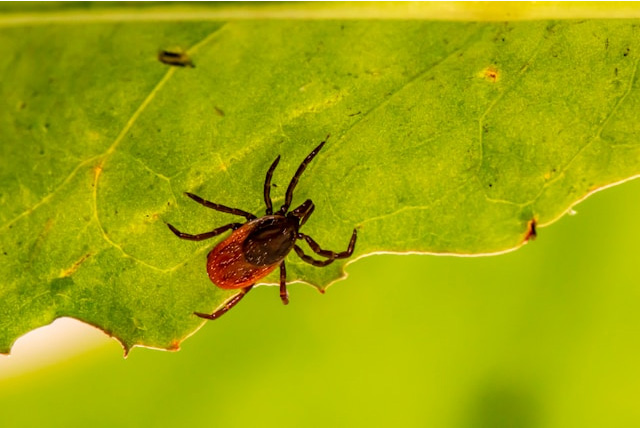
Tick parasites can attach to us and draw off blood without triggering an immune reaction because they produce proteins known as evasins that bind to and block the action of host chemokines that would normally send immune cells to attack the invader.
Researchers at Monash University Biomedicine Discovery Institute have now identified a tick-derived evasin, (called EVA-ATL) that can bind to two major classes of chemokines, known as CC and CXC. The researchers’ structure function analyses unveiled structural features of the EVA-ATL evasin that enable this dual specificity.
Until now, scientists had identified only evasins that selectively block chemokines within a single class. The team says the discovery has implications for the development of therapeutics targeting inflammatory and autoimmune diseases such as rheumatoid arthritis (RA) and multiple sclerosis (MS).
“The discovery opens up new opportunities to develop therapies that target chemokines driving inflammatory diseases such as RA and MS,” stated Shankar Raj Devkota, PhD, who is co-first author on the team’s published paper in Structure. “While treatments are available, there remains a significant need for therapies that more effectively prevent disease progression.” Co-first author Surendra Kunwar, added, “… in this study, we have identified a naturally occurring evasin that can inhibit both major classes of chemokines. This is a novel finding and represents a significant advance in the field.”
Devkota and colleagues reported on their work, including the results of structural evaluation of EVA-ATL, in a paper titled “Discovery of an evolutionarily distinct evasin with dual CC and CXC chemokine inhibitory activity.” In their paper the researchers concluded “EVA-ATL represents a natural evasin with broad-spectrum CC/CXC chemokine inhibition, offering a promising framework for next-generation immunotherapeutics for complex pathologies involving both chemokine families.”
When the immune system detects a harmful or foreign agent it triggers an inflammatory response and small proteins called chemokines direct immune cells to the site of the injury or infection, resulting in the invader being inactivated. “Inflammation is a critical part of the body’s defense mechanism, by which the immune system detects harmful or foreign agents and initiates the healing process,” the authors wrote.
Chemokines are divided into two main groups, CC and CXC, based on the spacing of conserved cysteine residues near their N-termini. But while chemokines are key to the body’s inflammatory defense mechanisms, dysregulation of chemokines and their receptors can lead to inflammatory and autoimmune disorders, including rheumatoid arthritis, multiple sclerosis, cancer and inflammatory bowel disease. “Targeting chemokine-receptor interactions, therefore, holds potential as a therapeutic approach to reduce immune cell recruitment and inflammation in these conditions,” the team continued.
Some parasites, including ticks, worms, and viruses, can evade the host’s immune response by secreting immunomodulatory proteins, including chemokine-binding proteins, they further explained. Ticks, for example produce chemokine-binding proteins known as evasins, which allow them to draw off a blood meal from mammalian hosts without triggering an inflammatory response.
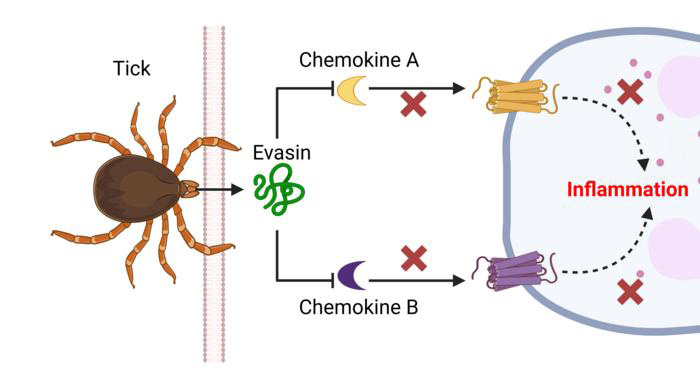
It was previously thought that ticks suppress the immune system by secreting a cocktail of different evasins, each targeting a specific class of chemokines. “However, the development of broad-spectrum therapeutics for inflammatory diseases such as cancers, rheumatoid arthritis, and other autoimmune disorders requires simultaneous targeting of both chemokine families, as they are frequently co-overexpressed in pathological conditions,” the investigators noted.
Through their newly reported study the researchers identified a class A3 tick evasin, EVA-ATL101 (EVA-ATL), secreted by Amblyomma tuberculatum, that has a dual CC/CXC inhibitory function. EVA-ATL, they showed, can bind to both CC and CXC chemokines to functionally suppresses chemokine signaling and chemotaxis mediated by both chemokine families, “…highlighting a rare dual-specificity profile with significant therapeutic potential.”
Using techniques including AlphaFold modeling, molecular dynamics simulations, and mutational analyses to investigate the structure of EVA-ATL, the team found that a shallower hydrophobic pocket at the evasin core enables the dual recognition of CC and CXC chemokines. “Structural analyses suggest that this expanded target range is conferred by distinct features in the chemokine-binding interface, particularly a shallower hydrophobic pocket in EVA-ATL, which accommodates the CC+1 and CXC+1 residues of chemokines, allowing the adjacent region of EVA-ATL to form backbone-backbone hydrogen bonds with both CC and CXC chemokines,” they wrote.
The overall findings, they suggested, provide structural insights into the molecular basis for dual chemokine recognition by EVA-ATL and offer a rational framework for engineering EVA-ATL, or other evasins, to broadly target both CC and CXC chemokines. “This discovery provides a unique scaffold for the development of broad-spectrum, chemokine-targeted anti-inflammatory therapeutics, particularly in disease contexts where simultaneous inhibition of both chemokine families is required.”