
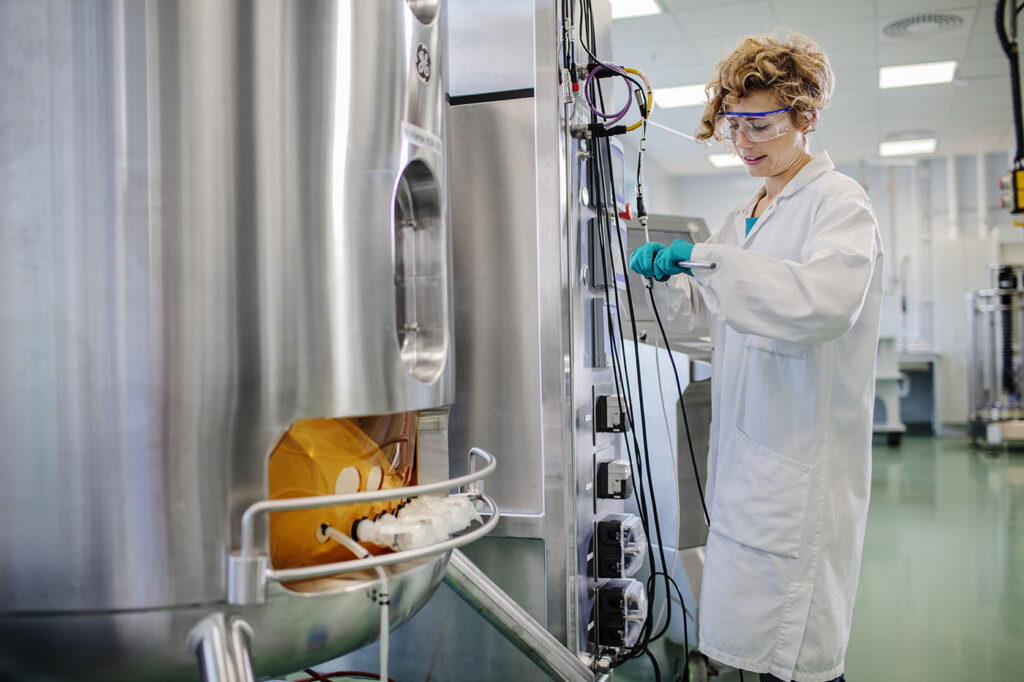
Today’s common bioprocessing technologies do not efficiently develop complex biologics like cell and gene therapy and mRNA products. The at-line monitoring, off-line analytics, and legacy control systems now in use restrict visibility into process conditions, cause biomanufacturers to rely upon retrospective data, and delay analysis, all of which together increase the risks of process deviations and delay production.
Consequently, “bioprocess monitoring is shifting toward in-online and on-line analytics,” Erik Martinsson, PhD, CEO, ArgusEYE, tells GEN. That shift will “support automation, enhance process control, and enable faster decision-making.”

Head, Portfolio and Applications
Eppendorf Bioprocess
While bioprocess engineers are adapting to in-line sensors and analytics, tools developers are looking at “integrated platforms that combine sensing, analysis, and control,” Simon Wieninger, PhD, head of portfolio and applications at Eppendorf Bioprocess, says. The goal is to make the next generation of monitors and controls easy to operate and easy to integrate into multi-vendor systems, “so companies can move from reactive to proactive process management.”
For that to happen, however, vendors must expand the use of standardized communications protocols to enable vendor-agnostic interoperability.
Connectivity & integration
“The biggest challenge—and I wish I didn’t have to say this—is still basic communications and connectivity,” Helena Öhrvik, PhD, senior manager, process design, Cytiva, says.
Citing “legacy systems and antiquated protocols,” Moira Lynch, director, innovation & strategic projects, Thermo Fisher Scientific, agrees that achieving seamless connectivity among equipment from different vendors is a significant challenge. “The lack of interoperability often leads to rigid workflows or forces costly workarounds that can slow production and stifle innovation.” Poor communications among devices also makes it difficult—if not impossible—to implement in-line process monitoring.
A commitment to open standards and vendor-agnostic platforms, therefore, is vital, Lynch says, “to ensuring that data-driven decision-making becomes standard practice.”

Head, Process Analytical Technology, Waters Corporation
Technology innovation, regulatory evolution, and organizational readiness also must align, Ranjeet Patil, head of the process analytical technology, Waters Corporation, says. “The tools are here, but adoption requires confidence.” That confidence probably will come once the monitoring, analytical, and control capabilities can scale between the development and manufacturing sites, and the analytics, automation, and process groups begin working more closely together, he predicts. “Integration into manufacturing…must be part of the process and not an after-thought.”
One of the challenges is the need to scale out rather than scale up. With therapeutics being tailored to ever-narrower niches, bioprocess engineers now need to automate many small bioreactors running in parallel rather than one large vat, and to integrate that data into a single source of truth, Wieninger says. That means more device integrations and, therefore, more potential points of failure.
The adoption of standardized communication protocols is easing that challenge. The Open Platform Communication (OPC) standard (introduced in 1996 for Windows, and which continues to expand to other systems) makes data integration possible among multiple devices from multiple developers, so manufacturers can adopt “best-of-breed” solutions for their processes.
Vendor adoption of the OPC standard is particularly important for smaller companies. “Big companies can afford to build specific systems with feedback loops and automation systems,” Öhrvik says, but small companies typically lack the in-house expertise and budget to do that. To standardize communications protocols for bioprocessing devices, she says, “There’s still some work to do.”
The challenge for tools developers, therefore, is to be at the forefront, Öhrvik says, “to work out the kinks and understand what’s working and what is not working…to make (these instruments) plug-and-play.”
Sensors
Another significant challenge is to develop sensors that are both robust enough for manufacturing environments and flexible enough for early development. As Martinsson observes, “Many sensor technologies emerge from research settings, where adaptability is prioritized.” They often are unsuitable for large-scale processes because of more rigorous demands around calibration, traceability, and data integrity.
The diversity and complexity of modern biotherapeutics constitute another major challenge, Martinsson says. “Providing meaningful data across this spectrum requires high sensitivity, strong anti-fouling performance, and tolerance to varying buffer conditions, pH, and flow profiles.”
Additionally, he continues, “Integration into existing processing equipment is often non-trivial. Bioprocess systems differ widely in format, hardware, and software. Sensor solutions must therefore be adaptable, scalable, and digitally compatible to support seamless implementation across diverse manufacturing platforms.”
The status today
The biopharma industry is known for its complex data sets and—with the help of AI—is beginning to maximize their value. As Öhrvik points out, “With AI, we can get more real-time data from upstream processes, such as how to feed that cell, what pH this cell line needs, how much lactate will be produced, etc.,” and use those insights to fine-tune downstream processes, making them more robust and efficient.
With so much data available, Wieninger says, “scientists also want easy-to-use cloud solutions to analyze that data and create knowledge and, therefore, insights about their processes.”
The status tomorrow
In the near future, Öhrvik predicts, “We will see much more automation for sampling beginning to end.” Offline sampling will be replaced by online and inline. “We see this with several techniques, such as mass spectrometry, in which robotics take samples and analyze them immediately with input from machine learning and AI.”
That insight into upstream conditions enables downstream processes to adjust accordingly. “Within the next 5 to 10 years, this flow will be completely automated,” Öhrvik says, although those systems will still require human supervision.
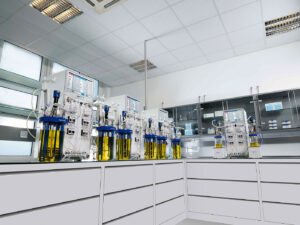
Patil reports a growing demand among bioprocess scientists for “interconnected systems that can support advanced control strategies, especially in high-throughput development or continuous processes. New synthetic molecules, such as xRNA molecules or synthetic peptides, present an exciting opportunity.”
Cytiva is working on different types of interconnected sensors for specific applications, such as buffer development and large-scale production.
Eppendorf sees opportunities in modular, autosampler solutions that integrate easily across upstream processes, Wieninger says. “Next-generation controller systems should enable multiparameter sensors for monitoring, require minimal maintenance, and offer compatibility with both reuseable and single-use systems.”
AI and the cloud
“We’re seeing a strong push toward real-time, high-resolution data and a more predictive, model-based approach,” Patil says.
Increasingly, bioprocessing models are based upon inputs from AI, physical and virtual sensors, and other mathematical and computational models, Öhrvik says. That combination ultimately makes bioprocessing faster and less subject to errors, she adds.
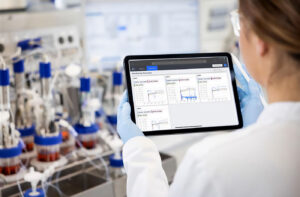
“The future will be more model-based,” Wieninger predicts, “and those models need to be trained.” Eppendorf already offers “cloud-to-cloud communications with AI providers,” he says, to develop and support such models.
Cloud computing is an integral tool in offering those easy-to-use solutions that allow scientists to monitor long-running processes even when they are away from the production facility. “It really helps give people peace of mind,” Wieninger adds. Eppendorf, for example, released a cloud-based monitoring solution for bioprocessing last year.
In the future, Wieninger predicts that model-based controls will make it possible to harmonize data from small-scale parallel systems, transfer it directly to AI systems, create models, and then link them back to the bioprocess stream to guide the process.
A lot still needs to happen before that fully integrated future is realized. Systems need to be ruggedized. Workflows need to be simplified, complexity reduced, and regulatory frameworks need to be met. Based on the work underway today, there is significant reason for optimism.