
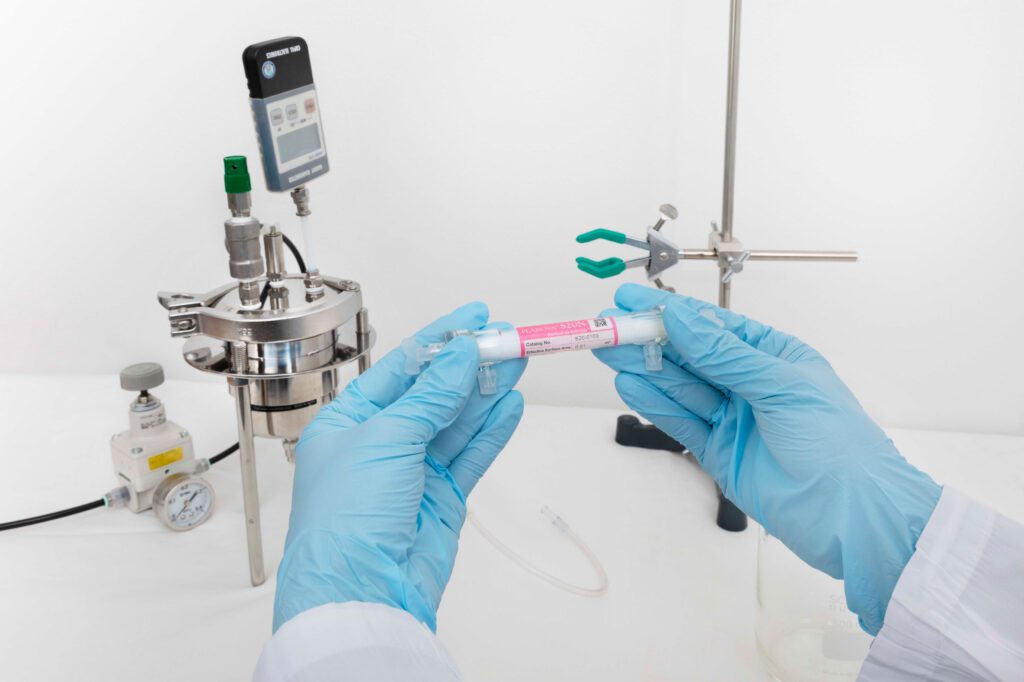
Biologic drugs—particularly antibody-based therapeutics—have become central to modern medicine. Virus removal filtration is an indispensable step in biopharmaceutical manufacturing to ensure viral safety in compliance with regulatory guidelines such as ICH Q5A. As the landscape expands beyond conventional IgG monoclonal antibodies to include bispecific antibodies, antibody-drug conjugates (ADCs), and Fc-fusion proteins, the challenges of viral filtration have grown accordingly. These engineered molecules can exhibit lower stability and heightened aggregation, leading to clogging and reduced filtration efficiency.
GEN discussed virus filtration history and optimization with Hiroki Fukutomi, manager of the Scientific Affairs Group at Asahi Kasei Life Science Corporation.
GEN: How does virus filtration fit into intensified bioprocessing strategies?
Hiroki Fukutomi: Virus filtration plays an important role in intensified bioprocessing because it must support both productivity and viral safety without becoming a bottleneck in downstream processing.1 Process intensification can take several forms, including increasing manufacturing throughput, enabling the production of increasingly diverse biopharmaceutical modalities, and supporting continuous manufacturing approaches. In each case, virus filtration must maintain robust virus removal while adapting to changing process requirements.

Manager, Scientific Affairs Group
Asahi Kasei Life Science Corporation
For blockbuster biologics used by large patient populations worldwide, manufacturing is often performed in large-scale facilities equipped with high-volume bioreactors. In this model, large-batch production is used to reduce manufacturing costs, and process intensification is generally directed toward improving throughput and shortening the time required for each unit operation. Virus filtration therefore needs to be performed efficiently while maintaining reliable virus removal.
At the same time, the industry is moving toward more targeted therapies and increasingly diverse treatment modalities. This includes products based on complex molecules and novel molecular formats. Such molecules may show more challenging filtration behavior, and virus filters can be susceptible to fouling or flux decay depending on the molecule, solution conditions, or process-related impurities. For this reason, filters that can provide consistent and robust filtration performance across a wide range of molecule types are increasingly important.
Continuous manufacturing represents another form of process intensification. In the process, virus filtration may be operated under conditions that differ from conventional batch operation, including prolonged processing and relatively low-flux filtration. Under these conditions, virus filters are expected not only to support efficient filtration but also to retain viruses reliably even at low flux.
Virus filtration therefore serves both as a critical viral safety step and as a unit operation that must adapt to intensified manufacturing formats. Its value depends on the ability of the filter to combine robust virus retention with stable filtration performance for large-scale production, diverse molecular formats, and continuous or low-flux processing conditions.
GEN: Where has filtration historically been limited?
Fukutomi: Historically, filtration has been limited in several areas, including high-throughput processing, difficult-to-filter feed streams, and operation under low-flux conditions. When high flux or high throughput is required, prefiltration is often needed to mitigate premature fouling of virus-retentive filters and maintain acceptable filtration performance. Protein aggregates and other process-related impurities can reduce virus filter throughput and cause flux decay, making prefilter selection an important part of process development. Although this can improve processability, it also adds work during process development, since the prefilter must be selected and evaluated as part of the overall filtration train.2 In manufacturing, this can increase the cost of goods and add to the number of consumables that must be managed.
Another limitation has been observed with process streams that are intrinsically difficult to filter. In these cases, regenerated cellulose-based filters have often been selected because their hydrophilicity and membrane structure can support consistent filtration performance for some challenging molecules or formulations. However, these filters have typically been constrained by a relatively low operating pressure limit. As a result, the achievable filtration flux can be low, which may require the use of multiple filters, larger membrane area, or extended filtration time at manufacturing scale.
In continuous manufacturing, virus filtration is often performed over extended periods at low flux and pressure, requiring stable virus retention under these conditions. However, the increased contribution of diffusion at low flux has been associated with a higher risk of virus breakthrough in some filter designs, depending on process conditions1.
Therefore, the historical limitations of filtration have not been limited to throughput or flux alone. They also include the need for prefiltration, constraints in processing difficult feeds, low pressure tolerance of some filter materials, and the challenge of maintaining robust virus retention during extended operation under low-flux conditions.
GEN: How are newer approaches improving speed without compromising performance?
Fukutomi: Newer approaches are improving filtration speed by optimizing membrane structure and surface chemistry for each membrane material. The objective is to increase flux while preserving the properties that make each material useful for virus filtration, including virus retention, fouling resistance, and process robustness. Material selection is also becoming more important as per- and polyfluoroalkyl substances (PFAS)-related regulatory discussions continue.
For high-flux filters, one approach has been to use polyethersulfone (PES) membranes because of their mechanical robustness and good chemical compatibility. The membrane structure was optimized, including pore size distribution, porosity, and other structural features, to support high flux while providing higher pressure tolerance, allowing the filter to be operated under conditions that would not be suitable for more pressure-limited membranes. In addition, hydrophilic surface modification of the membrane helps reduce interactions with proteins, aggregates, and other impurities in the feed stream. At the same time, control of the size-selective region and internal void structure is important for maintaining virus retention while increasing permeability. As a result, the filter can combine high flux with reduced susceptibility to clogging and reliable virus removal performance.3
For regenerated cellulose-based filters, similar design principles can be used to preserve the inherent hydrophilicity of the material while improving pressure tolerance and flux. Optimization of membrane structure can make it possible to improve pressure tolerance while maintaining the benefits of a hydrophilic surface.4 A gradient pore structure can further improve processability by distributing foulants within the membrane and reducing rapid blockage at the surface.
In this way, newer virus filtration approaches improve flux through an integrated design strategy that balances permeability, pressure tolerance, fouling resistance, and virus retention. This balance is important because higher flux alone would have limited value if it compromised viral safety or caused rapid filter fouling.
GEN: How does optimizing individual steps support overall process efficiency?
Fukutomi: Optimization of individual unit operations can have a direct impact on overall process efficiency, particularly when the step is complex, costly, or safety critical. Virus filtration is a good example. Because virus removal filters are used to assure viral safety, filter integrity is typically confirmed before and after use. When a process requires many virus filters, each filter adds handling, preparation, integrity testing, documentation, and operational control. Increasing filtration speed and reducing the number of filters required can therefore reduce not only filtration time, but also the workload associated with these supporting operations.
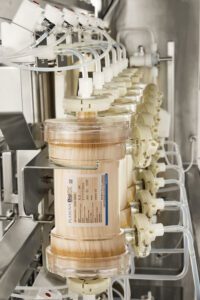
Virus filtration can also represent a significant contributor to downstream processing cost when filter devices, buffers, system setup, and consumables are considered. When robust virus filtration can be achieved without prefiltration, the filtration train can be simplified, reducing development effort, consumable use, and the number of components that must be managed during manufacturing. Scalable formats, including hollow-fiber designs, can further support manufacturing implementation by allowing membrane area to be increased while maintaining the same basic filtration format.
In continuous manufacturing, integrating virus filtration as a continuous or semi-continuous operation can reduce the need for intermediate hold tanks, thereby decreasing equipment footprint in intensified downstream processes. Longer filter operation may also improve utilization of membrane area and filter capacity, rather than limiting filter replacement to a short batch processing window. Together, these improvements can help lower the filter cost per unit of product.
Therefore, optimizing virus filtration can improve process efficiency beyond the filtration step itself by reducing filtration time, labor, the burden of consumables, the equipment footprint, and the overall manufacturing cost.
Hiroki Fukutomi is manager of the Scientific Affairs Group at Asahi Kasei Life Science Corporation.
References
- ICH Harmonised Guideline. Viral Safety Evaluation of Biotechnology Products Derived from Cell Lines of Human or Animal Origin Q5A(R2). International Council for Harmonisation of Technical Requirements for Pharmaceuticals for Human Use; 2023.
- Stanevich, V., et al. Improving viral filtration capacity in biomanufacturing processes using aggregate binding properties of polyamide-6,6. Biotechnology & Bioengineering 2021; 118: 1105–1115; doi: 10.1002/bit.27634.
- Michikawa, K., et al. Ensuring Biopharmaceutical Safety with a Novel, high-Throughput Virus Removal Filter. BioProcess International 2025.
- Hongo-Hirasaki, T., Fukutomi, H. Performance features of virus removal filters with novel regenerated cellulose hollow fiber membranes. iScience 2025;28(2); doi: 10.1016/j.isci.2024.111701.