
When the molecular Ornstein-Zernike (MOZ) equation was solved a decade ago, the physics community rejoiced. That equation had been a bottleneck for 40 years, making it difficult to predict molecular interactions in a liquid at the atomic scale.
What most surprised physicist Maximilien Levesque, PhD, the physicist who solved that equation, now CEO of Aqemia, was that the biopharmaceutical world was excited, too. Several biopharma entities reached out to him.
He was puzzled. “Why would you want this technology that’s used for nuclear research and applications?” he asked. “They told me, ‘Oh, for free energy calculations. The thing you calculate with your solution is tremendously important in drug discovery.’ I said, ‘Tell me more,’ and that’s how I learned about drug discovery.”
Levesque received multiple offers to acquire the technology, which only underscored its potential and inspired him to embrace the risk of entrepreneurship. That was about seven years ago. Since then, Levesque and co-founder Emmanuelle Martiano-Rolland, COO, formerly a principal with the Boston Consulting Group, have built Aqemia into one of the few companies in the world that applies quantum physics and AI to drug discovery.
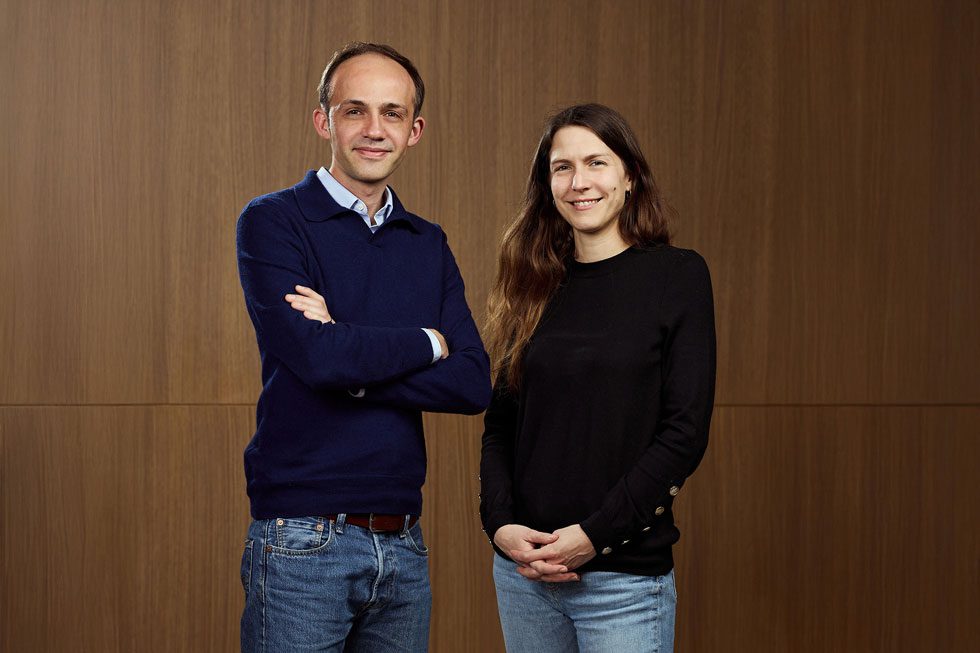
“Our mission is to invent the right molecules,” Levesque tells GEN. Rather than train the AI on molecules that already exist and thus invent similar, me-too molecules, “We teach First Principles to the AI, so it is able to invent a completely new class of molecules,” he explains.
“Our differentiation is that we are not restrained to inventing molecules that look like existing molecules. By training the AI on the physics, we can pursue unexplored avenues and create other effective combinations that may never have been thought about,” Levesque emphasizes.
In practical terms, this means creating what chemists call “exquisitely active and selective molecules” that can distinguish between two therapeutic targets that may be differentiated by only a few molecules. This goes beyond what’s possible with usual generative AI, he explains. “If you train on existing data, you can only solve therapeutic problems close to those already solved.”
Exquisitely selective
Aqemia is pursuing two types of programs using its platform to blend generative AI and physics. The first—and the company’s primary focus—is its internal platform. While some programs are in animal testing, the bulk of the programs are what Levesque calls pre-programs. Approximately 60 of these early-stage programs are being investigated in four categories: pancreatic cancer, glioblastoma, and ovarian cancer, and a separate set of undisclosed targets that Levesque says are “meant to demonstrate the platform with targets of intense interest to pharmaceutical companies, such as selective KRAS mutants or CDKs or cRAF.”
These programs run in parallel and involve multiple different mechanisms of action. So far, 10 programs have emerged from those pre-programs and, of those, “Three have shown superior efficacy and no toxicity in the animal model of cancer,” Levesque says. “What I call superior efficacy is typically a superior tumor growth inhibition [compared to] the competition,” he explains. They are not yet in the preclinical phase.
[Aqemia]
The second category of program underway at Aqemia is collaborative. Working jointly with Sanofi, Johnson & Johnson, Servier, and Novalix, Aqemia is developing novel molecules to advance their programs or to predict the potency of certain small molecules against given targets. The Sanofi collaboration, he says, “is for a small pool of programs in many therapeutic areas,” in a deal that is worth as much as $140 million.
Milestones
“Our most important [milestone] is getting the first molecule into the clinic,” Levesque says. “We are building a large pipeline of programs, but none have yet entered the clinic. I expect that will happen within the next 18 months.”
In 2022, venture capital firms nominated Aqemia as one of the 21 most promising health tech startups. The reason was its speed and accuracy in developing useable molecules. That is directly related to its multidisciplinary nature. “We’re not a biotech…we’re not a tech company selling software. We are a mix of physicists, mathematicians, biologists, chemists, software engineers, machine learning researchers….”
In this multidisciplinary, multinational company, “Communications here is key,” Levesque says. The company ensures town hall-type meetings occur regularly to ensure everyone knows the company direction and major initiatives and has the opportunity to have their questions answered.
While the scientists are advancing the programs, the business side of the company is expanding, too. Staff numbers have increased from around 60 at the beginning of 2026 to around 90 mid-year, with the total expected to be well above 100 by mid-2027. About two-thirds are in the Paris headquarters with the rest in the London office. The search also has begun for key personnel to open a U.S. office.
Upon expanding into the U.K., “The first objective for the U.K. office was to recruit life sciences talent who embrace the blend of technology and life science,” he says, and who also “want to embrace our culture and bring theirs.” The London office is located in London’s Knowledge Quarter, near both the Crick Institute and DeepMind, and across from the Eurostar terminal at the British end of the Chunnel, which eases movement between offices.
Since its formation, the company has secured more than $100 million in funding from investors that include Cathay Innovation, Wendel, Bpifrance Large Venture, Eurazeo, and Elaia, in addition to milestone payments from its collaborative partners. It also received a $7.4 million grant from the France 2030 plan, a national investment strategy designed to enhance innovation. The grant supports research to target RNA with small molecules.
Before Aqemia
Before co-founding Aqemia, Levesque’s professional world centered around disordered condensed matter applied to nuclear physics. He was a professor of statistical mechanics and quantum physics at the École Normale Supérieure, Paris, and at the Centre National de la Recherche Scientifique (CNRS), Paris. He performed his doctoral research at the French Alternative Energies and Atomic Energy Commission (CEA)— “the French Los Alamos,” he says—and conducted post-doctoral work at the University of Cambridge and University of Oxford. “Most of what I was doing was applied to the nuclear field.”
Since solving the MOZ equation, his focus shifted. Now, he says, “My goal is to invent many new drugs, in a way that is predictable and systematically improving,” by teaching the laws of physics to generative AI.