
Sponsored content brought to you by

Digital PCR (dPCR) earned its reputation by solving a real problem: it let researchers count nucleic acid molecules directly, without leaning on a standard curve. But the method works by assuming something it cannot verify—that each of a limiting number of droplets holds no more than one target molecule. At low concentrations, that assumption mostly holds. Push the input higher, or add a few more targets to the same reaction, and multiple target molecules start sharing individual partitions. At that point, the instrument is no longer counting and is instead estimating using Poisson statistics.
The gap between what dPCR promises and what it can reliably deliver as target input and multiplexing needs surpass dPCR thresholds, is directly addressed by Countable Labs, whose single molecule counting PCR platform was the subject of a recent GEN webinar. Rather than relying on statistical inference, the company’s technology partitions a sample into a gel-like matrix having approximately 30 million discrete compartments, physically separating individual molecules for direct counting, across the widest-available dynamic range.
Testing this claim under real lab conditions fell to Alex Zevin, PhD, director of the Genomics Shared Resource at Fred Hutchinson Cancer Center. His core facility, which supports more than 100 investigators and processes more than 10,000 samples a year, has spent the past decade layering on quantification technologies: The Nanostring nCounter® technology in 2014, ABI QuantStudioTM 5 instruments in 2017, the BioRad QX200TM digital droplet PCR system in 2024, and, since mid-2025, a Countable Labs demo unit that has successfully processed hundreds of samples across nine labs.
Counting instead of correcting
The mechanics matter here. Standard qPCR analyzes a sample in bulk and needs a standard curve to translate a threshold cycle into a quantity. Droplet dPCR and dPCR systems distribute samples across a relatively low number of partitions, subjecting these techniques to sensitivity issues outside of a limited dynamic range. Countable PCR partitions samples at a level that is orders of magnitude greater than that of dPCR by isolating single molecules in a proprietary matrix and performing readouts for direct counting of positive partitions, using 3D light-sheet imaging. It also uses a proprietary universal multiplexing chemistry that sidesteps design constraints of multiplexed assays available on other platforms.
Putting it to work
Zevin highlights early results that instilled confidence in the Countable Labs platform. One example he shared involved an Illumina library quantification assay, built simply by tagging existing P5 and P7 primers with the platform’s adapter sequence. It produced a linear response against commercial standards and tracked closely with results from the KAPA Library Quantification Kit, the method his lab already trusted. “What this told me is that we could easily switch our quantification from qPCR to a Countable PCR-based readout,” Zevin said.
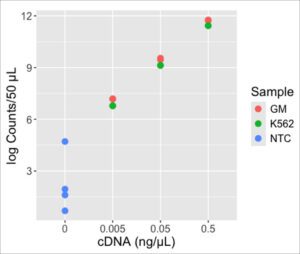
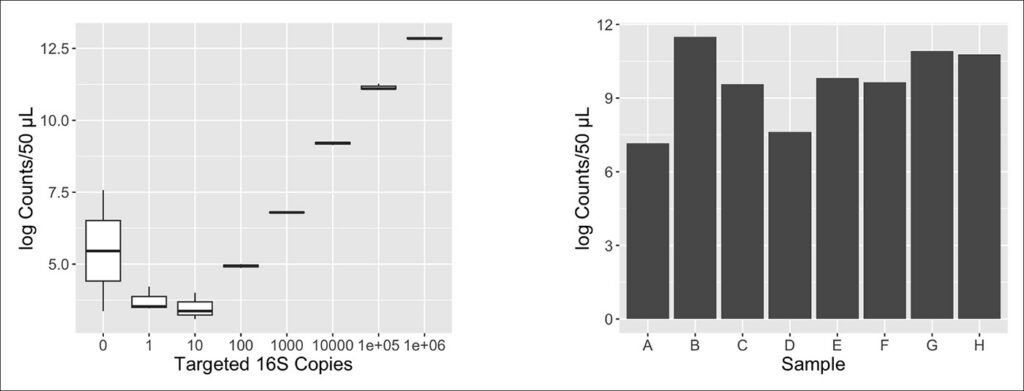
Similar patterns turned up elsewhere. Working with primers and cDNA from the lab of Steve Henikoff, PhD, at Fred Hutchinson Center, Zevin’s team saw improved sensitivity quantifying GAPDH transcripts in comparison to their existing qPCR approach (Figure 1). A 16S ribosomal RNA assay, built with primers from the lab of David Fredericks, MD, also at Fred Hutchinson, held a linear response across six orders of magnitude down to roughly 10 input copies (Figure 2). It also successfully processed microbiome samples from the lab of Neelendu Dey, MD, another Fred Hutchinson collaborator.
The most clinically weighted example involved BCR-ABL/ABL1 fusion detection, which is central to acute myeloid leukemia. Using an off-the-shelf Countable Labs assay, the lab accurately detected positive signals from as little as 55 picograms of input RNA. That work has since grown into another collaboration at Fred Hutchinson, this time with the lab of Jerald Radich, MD, to compare the assay against validated clinical assays and evaluate its precision across multiple sites.
In her portion of the presentation, Rachel Kane, Countable Lab’s director of business development, discussed a JAK2 V617F example that detected 31 mutant alleles against roughly 773,000 wild-type copies, a sensitivity she put at ten times that of digital PCR. She also described a design in which isolating molecules before amplification means a four-target multiplexed reaction returns the same counts as four separate single-target reactions, avoiding probe competition factors that erode precision on other platforms, as multiplexing increases.
What comes next
Where Countable Labs sees the platform heading matters as much as where it has already been. For Zevin, the more immediate future applications are close to home: HIV reservoir detection, where a shrinking reservoir under treatment demands ever more sensitive assays, alongside pharmacogenomic SNP panels and mycoplasma contamination screening. Countable Labs, for its part, has named Fred Hutchinson its first certified service provider, currently serving researchers across the Seattle region. And the company is continuing to build its list of service providers.
Absolute counting quietly becomes statistical correction once concentration or multiplexing climbs. That’s the exact problem a design built around physical isolation is meant to resolve. Whether it holds up at scale and across sites is still being tested. But as Kane put it, “Digital PCR changed what was quantifiable. Single molecule counting changes what’s measurable.”