
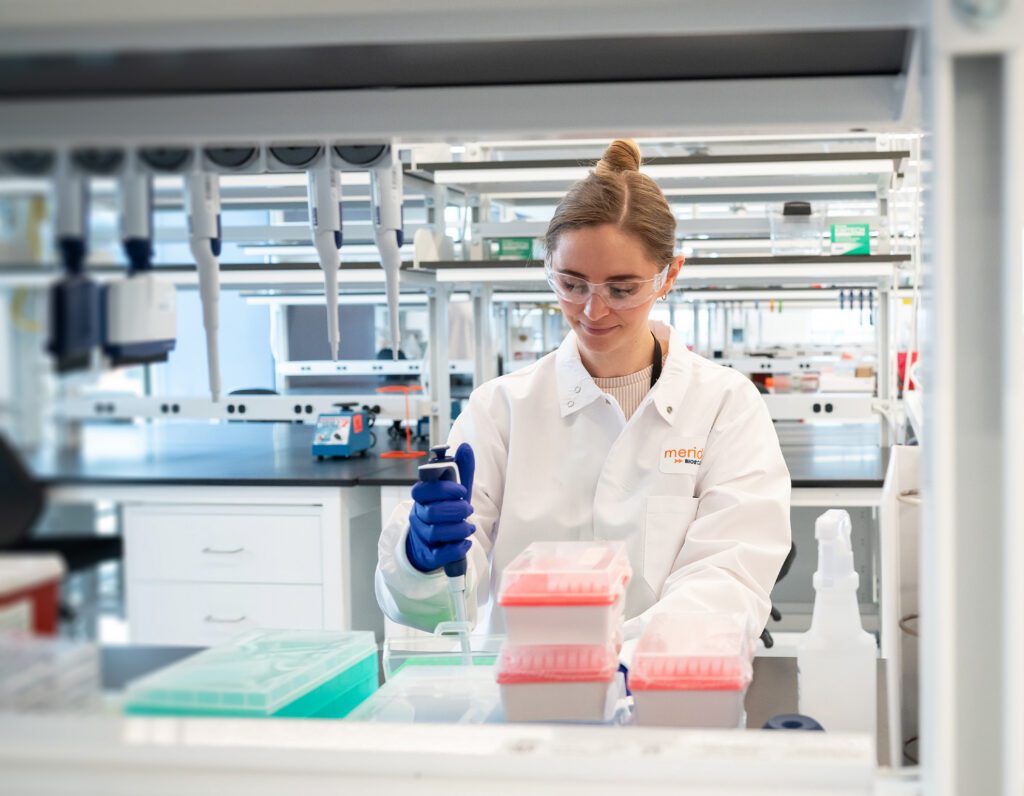
Eli Lilly’s biotech buying spree continues as the pharma giant is planning to carry out its 13th buyout of a biotech this year, agreeing to acquire Merida Biosciences, a developer of precision therapies for serious autoimmune and allergic diseases, for up to $2.875 billion, the companies said.
Based in Cambridge, MA, Merida develops biologic drugs that are engineered to selectively degrade pathogenic autoantibodies linked to a number of immune-mediated conditions. Merida has said its precision degradation approach aims to address the biological cause of these diseases, rather than broadly suppressing the immune system as done by many current treatments.
“We see this acquisition as further evidence of mgmt [management]’s intent to diversify LLY’s pipeline beyond obesity,” David Risinger, a senior managing director and senior research analyst covering diversified biopharmaceuticals at Leerink Partners, wrote Monday in a research note.
Merida’s lead program is MER511, a monomeric TSHR-IgG fragment crystallizable region (Fc) fusion protein being developed for Graves’ disease and thyroid eye disease (TED). Both conditions are driven by thyroid-stimulating immunoglobulins that activate thyroid-stimulating hormone receptors (TSHR) in the thyroid gland, triggering excess thyroid hormone production and accelerating metabolic activity.
MER511 is designed to bind and neutralize anti-TSHR autoantibodies, leading to clearance and degradation via FcγRIIB, the sole inhibitory Fc receptor for IgG, in liver sinusoidal endothelial cells (LSECs) while concurrently inhibiting antigen-specific B-cell function.
At the Endocrine Society’s ENDO2026 conference held June 13-16 in Chicago, a research team shared detailed study plans for the Phase I NEXUS trial (NCT07305818), designed to establish initial safety, tolerability, pharmacokinetics, pharmacodynamics, and immunogenicity of MER511 to support its further clinical development in Graves’ disease.
“Data from in vitro and in vivo studies provide evidence that MER511 may directly address the underlying pathology of GD [Graves’ disease] by these targeted mechanisms, allowing for restoration of normal thyroid function,” the researchers stated.
NEXUS’ primary endpoints are number of participants with treatment-emergent adverse events, and number of participants with clinically significant changes in ECGs, vital signs, clinical laboratory values, and physical examination.
Graves’ disease affects approximately three million people in the U.S., of which roughly 25% to 40% go on to develop TED. While both conditions can be treated, present-day therapies do not target the autoantibodies that cause both disorders.
Beyond lead program
Lilly and Merida reason that Merida’s platform has potential application well beyond its lead program. The company’s pipeline also includes MER769, a preclinical program focused on food allergy, asthma, chronic spontaneous urticaria, and other diseases driven by the antibody responsible for triggering allergic reactions.
Also in Merida’s pipeline are earlier preclinical-stage programs in kidney diseases such as membranous nephropathy and other immune-mediated conditions.
“We see potential to apply this precision approach across a broad range of antibody-driven diseases, and we look forward to advancing this novel technology working with the Merida team,” Francisco Ramírez-Valle, MD, PhD, senior vice president, Lilly immunology research and early clinical development, said in a statement.
Ramirez-Valle added that initial Phase I data “already pointed to the potential for improved efficacy and safety.”
Lilly agreed to acquire Merida for up to $2.875 billion consisting of an upfront payment and payments tied to achieving milestones. Lilly is flush with cash on the commercial strength of its blockbuster metabolic drugs
The acquisition deal is subject to customary closing conditions, including regulatory approvals, and is expected to close in the fourth quarter.
Lilly shares traded on the New York Stock Exchange dipped 1.5% Monday, sliding from $1,174.61 to $1,156.73.
Merida launched last year with $121 million in Series A financing co-led by Bain Capital Life Sciences, BVF Partners and Third Rock Ventures, joined by GV (Google Ventures) and Perceptive Xontogeny Venture Funds (PXV Funds).
“Under our CSO and founder Dario Gutierrez’s scientific leadership, our team has advanced that idea from concept to clinical data, and what we’ve seen so far reinforces our conviction that this approach can make a meaningful difference for patients,” Merida CEO Adam Townsend stated. “Today’s announcement reflects the hard work of the entire Merida team, and joining Lilly gives our science the resources and commitment to realize its potential for patients with immune-mediated conditions.”