
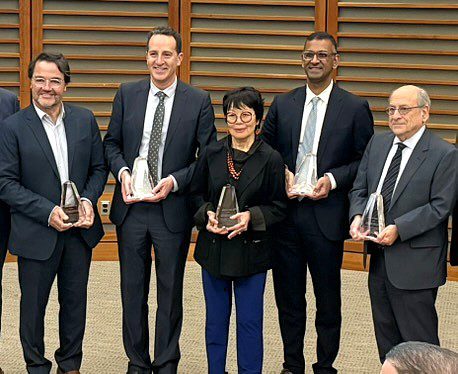
BOSTON—Four physician scientists and a molecular geneticist from Harvard Medical School (HMS) and the National Institutes of Health (NIH) were honored last week with the 2026 Warren Alpert Foundation prize.
Stuart Orkin, MD, and his former trainees Vijay Sankaran, MD, PhD, and Daniel Bauer, PhD, were joined by Swee-Lay Thein, MD, PhD, and John Tisdale, MD, both at the NIH. Their contributions helped to identify BCL11A as a major regulator of the fetal-to-adult hemoglobin switch, paving the way for the development of the first CRISPR medicine, Casgevy, for sickle cell disease (SCD) and thalassemia.
Opening the symposium, HMS Dean George Daley, MD, paid tribute to Janet Watson, MD, the Brooklyn pediatrician who concluded in 1948 that fetal hemoglobin (HbF) was somehow protective against SCD. “The mechanism behind the switch would remain an enigma for decades,” Daley said.
Each of the five honorees had “distinct and complementary roles” in the effort, Daley said, which culminated in the approval in December 2023 of Casgevy as well as Lyfgenia, a beta-globin gene therapy. Thein and Sankaran identified and characterized BCL11A as a critical regulator of HbF expression. Orkin and Bauer identified the enhancer sequence within BCL11A that controls erythroid gene expression and would become the specific target for Casgevy to restart HbF production.
“We should hustle to make therapies that are simpler, safer and scalable,” Daley said. Bolstering newborn screening for SCD and expanding global distribution would be major steps to producing a bigger impact, such that “fewer people will have their lives upended by these devastating hemoglobinopathies.”
Editing out disease
The symposium’s keynote speaker—2020 Nobel laureate Jennifer Doudna, PhD—said, “Drug success requires a deep understanding of biology.” Having a functional cure for SCD less than 15 years after her team’s initial development of CRISPR-Cas9 gene editing was “just incredible,” she said.
Doudna paid particular credit to patient volunteers such as Victoria Gray and Jimi Olaghere. “You can’t have success if you don’t have people willing to try it,” she said. According to Doudna, Casgevy is now approved in 39 countries across North America, Europe, and the Middle East. More than 90 percent of SCD patients in the U.S. qualify for reimbursement coverage for Casgevy. And more than 500 patients globally have begun Casgevy treatment.
Naturally, challenges remain. Doudna focused on four: 1) Conditioning toxicity, 2) cost, 3) infrastructure, and 4) expanding global access. “How do we get from one CRISPR therapeutic to CRISPR-for-many? I think it’s achievable,” she said, citing the 2025 Baby KJ story as an example. In vivo gene editing will be critical in the future, Doudna said, but the toolbox for delivery is growing fast. She noted two recent preprints from her lab advancing novel strategies—NANITE and JET—as examples of works in progress.
Beginning with BCL11A
The symposium was organized by Ed Benz, MD, a renowned hematologist and President and CEO emeritus of the Dana Farber Cancer Institute. In SCD, the red blood cells (RBCs) become rigid and adhere to blood vessel walls. Tissues become ischemic resulting in pain crises and start to deteriorate. Many patients lose the function of key organs, especially the kidney, heart, and lungs. Life for people with SCD is “constantly dealing with pain, anemia, brain fog, etc. They rarely live a normal lifespan.”
Orkin noted that this was not his first time winning the Alpert prize. He previously won in 1993 for his research providing a complete molecular genetic description of thalassemia. “A lot has happened in 33 years,” Orkin joked, noting profound changes in presidents, AI, and scientific landmarks.
Orkin’s team has spent years defining the mechanism of BCL11A regulation of globin gene transcription, a process he likened to “going to the thermostat.” He highlighted a key paper along the way led by his former trainee Jian Xu, PhD, now at St. Jude Children’s Research Hospital. In 2011, Xu took an SCD mouse model, knocked out the Bcl11a gene in the erythroid lineage, and rescued the phenotype of RBCs. This prevented SCD symptoms and validated BCL11A as a therapeutic target in humans.
The Casgevy results, Orkin said, were “spectacular… remarkable, transformative.” Orkin listed several advantages of the HbF reactivation pathway (as opposed to correctional gene therapy), including the validation provided by Casgevy; the balance of globin gene expression, and the fact it offered “one-stop shopping” for all hemoglobinopathies. But this ex vivo approach cannot reduce the global burden of SCD and thalassemia, Orkin said. Reasons include high cost, the complex nature of the process, and a lack of infrastructure.
Still, the clinical success of Casgevy points to a clear target for small molecule drug discovery programs. “I argue that BCL11A is the preferred target,” Orkin continued. The protein acts directly on the gamma-globin promoter and has a steeper dose-response than other regulators, such as LRF. The protein “looks like spaghetti,” based on AlphaFold, Orkin said. It is an obligate multimer, which is critical for gene repression activity.
Although highly stable, BCL11A is degraded in proteasomes as a monomer, raising the possibility that this pathway provides targeting opportunities for small molecules. “The goal should be development of therapies that can be delivered to the majority, if not all, patients with SCD and thalassemia,” Orkin closed.
Oxford calling
The focus of Thein’s research, beginning in Oxford when she joined Sir David Weatherall’s group in 1982, was a tantalizing question: Why are some patients with beta-thalassemia relatively mild and transfusion-independent?
Thein focused on two large hemoglobinopathy families, finding high levels of HbF reduced the need for blood transfusions. She also found that HbF levels were independent of inherited mutations in the beta-globin gene.
In 2007, Thein and colleagues performed a groundbreaking genome-wide association study (GWAS), looking at more than 5,000 participants of Northern European descent. Those with extreme phenotypes were genotyped using a panel of 300,000 single nucleotide polymorphisms. One of the three major signals was an unexpected signal that mapped to chromosome 2, which Thein further refined to the second intron of BCL11A. That unexpected signal eventually became a therapeutic target.
Sankaran and Orkin independently confirmed Thein’s findings. That study was published in 2008 in Science. But how to go after BCL11A? Ironically, Sankaran observed, the answer was on the next page of the journal: a landmark paper in the early stages of CRISPR research published by Luciano Marraffini, PhD, and Eric Sontheimer, PhD. “I wish I’d paid more attention!” Sankaran quipped.
Sankaran asked: How can we improve available hemoglobinopathy therapies globally? “We need to invest in all of these pathways—ex vivo, in vivo, and small molecules,” he said. With perfect timing, Sankaran’s team had just published an interesting new candidate for an HbF regulator—BACH2, which inhibits binding of NRF2. Although very early days, inhibiting BACH2 offers another intriguing drug target. “Much more biology remains to be understood,” he said.
Gene replacement
While the other four awardees played a role in characterizing the Casgevy pathway, Tisdale was recognized for his work as the lead clinical site for the Lyfgenia trial, sponsored by Bluebird.
“When I hit the scene in the ‘90s, we had zero drugs to treat [SCD],” he said. The disease produces complications “literally from head to toe,” including strokes in children. The pain is so crippling that patients “can’t plan and can’t hold a job.” Building on the first allogeneic bone marrow transplant in 1996, by Mark Walters, MD, Tisdale’s group looked for less toxic chemotherapy options and established a non-myeloablative approach.
“Luigi Naldini threw us a lifeline,” Tisdale said, with a report in Science in 1996 that lentiviruses could transduce non-dividing cells (like HSCs). Deleting the 3’ LTR reduced the risk of integration turning on adjacent genes. Tisdale’s group partnered with Bluebird for the HBG-206 clinical trial. While initial results were modest, in the Group C cohort, successfully treated patients behaved as if their disease had resolved to sickle cell trait. Lyfgenia was also approved by the FDA in December 2023 and is currently sponsored by Genetix Pharmaceuticals.
Tisdale was asked how he counsels patients interested in signing up for gene therapy. “Most patients don’t understand the options,” he said. The discussion starts with a bone marrow transplant, but many insist they want gene therapy. “The first thing is to optimize hydroxyurea,” which is an inclusion criterion. “Most [patients have failed to try; many can improve that way, especially children.”
Cognitive dissonance
“Our field is facing a moment of cognitive dissonance,” said Bauer, in the fifth and final talk from the 2026 laureates. The excitement over gene therapies is balanced, he said, by “the frustration that current therapies are too complex to even dent the global burden of disease.”
Bauer briefly described prime assembly, a new technology from his lab led by grad student Sebastian Levesque, which was published in Nature last month. The technology shows similar activity in dividing and non-dividing cells and “raises the prospect of mutation-agnostic gene correction for many diseases.”
At the American Society for Hematology conference in 2016, Bauer recalled showing a slide of a mountain with several paths drawn to the top representing different potential approaches for treating SCD. He juxtaposed that slide with a photo of Casgevy trial volunteer Jimi Olaghere proudly standing at the summit of Mt. Kilimanjaro in 2024.
The field has come a very long way, but still has further to travel.