
Fat—adipose tissue—is more complicated than might be thought. Once considered just a bag of calories, scientists now know that fat doesn’t just squirrel away energy, it also sends and receives hormonal, nervous system, and immune signals.
A study led by researchers at Stanford Medicine has now found that fat plays another role. The findings showed that a type of abnormal adipose tissue known as “creeping fat” (CF) triggers debilitating scarring in the intestines of people with Crohn’s disease (CD).
The results indicate that stiff, finger-like deposits of creeping fat that encase the intestines of Crohn’s disease patients are not just bystanders, they worsen the disease. The mechanism is surprisingly similar to the way scars form elsewhere, such as on the skin, the researchers said.
Physicians currently lack therapies to keep these scars from forming, and the only treatment is surgical excision. The newly reported study, headed by Jeong Hyun, MD, assistant professor of pediatric surgery, revealed potential molecular targets for drugs that could prevent formation of the scars, known as strictures, which could greatly benefit Crohn’s disease patients.
“These patients really struggle,” said Hyun, who treats Crohn’s patients, performing surgery to remove strictures. His patients tell him that in addition to feeling physically debilitated, they feel frustrated by being unable to control when or for how long their symptoms will upend their lives. “My heart goes out to them,” he said. “There’s a lot of suffering here that we think we can alleviate.”
Hyun, together with Michael Longaker, MD, the Deane P. and Louise Mitchell Professor in the School of Medicine, are co-authors of the team’s published paper in Cell, titled “Creeping fat-derived mechanosensitive fibroblasts drive intestinal fibrosis in Crohn’s disease strictures.” The study’s lead author is Khristian E. Bauer-Rowe, an MD/PhD student at Stanford School of Medicine. Researchers from Case Western Reserve University School of Medicine and the Icahn School of Medicine at Mt. Sinai contributed to the research.
Crohn’s is a severe intestinal disease that commonly begins in the teen or young adult years. It’s marked by cycles of intestinal inflammation, mostly in the far end of the small intestine and the bowel. Patients suffer from abdominal pain, diarrhea, malnutrition, weight loss, and fatigue.
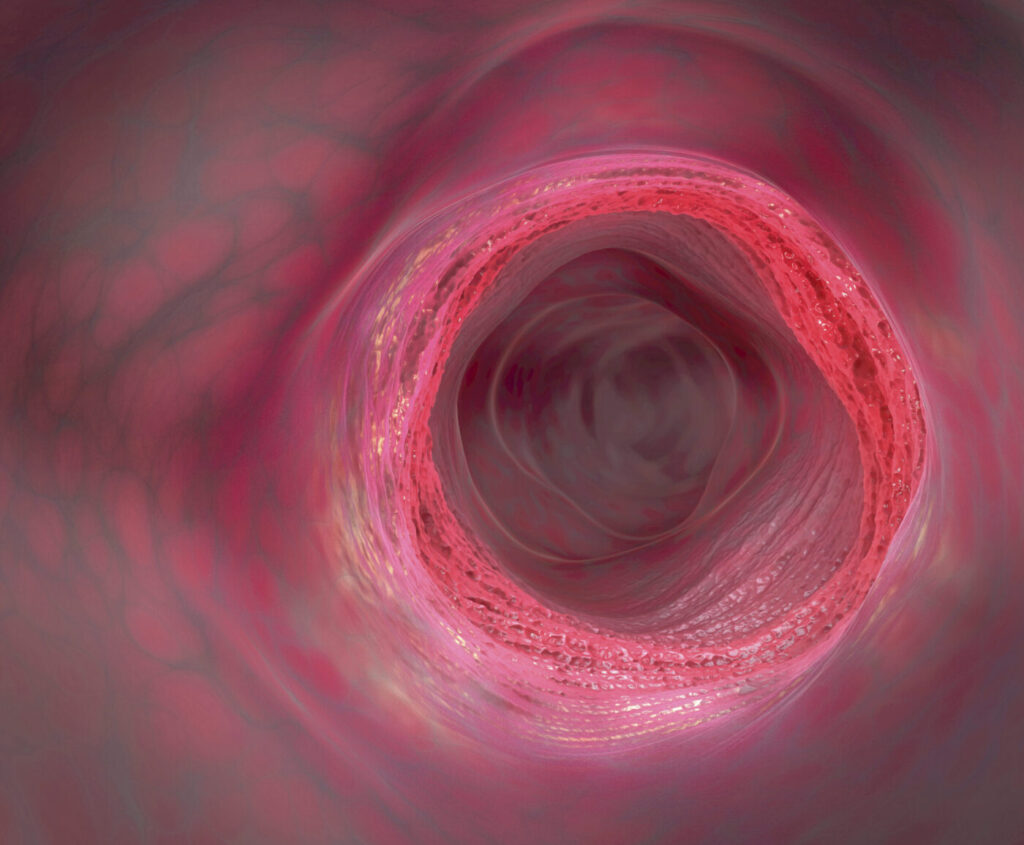
Anti-inflammatory drugs sometimes control the problem, but if chronic inflammation takes hold, the intestine can become stiffened and narrowed with scar tissue—a stricture. “A significant complication of Crohn’s disease (CD) is intestinal fibrosis, which narrows the bowel lumen to form a stricture,” the authors wrote.
Strictures, which often form at the valve that joins the small intestine and the bowel, can affect up to 80% of those whose disease isn’t put into remission by anti-inflammatories. Surgery isn’t necessarily a long-term solution. And as the authors further noted, “… no anti-fibrotic therapies have been approved. Thus, strictures cause significant morbidity in CD patients.”
Longaker said, “The recurrence rate is high, and once you start cutting strictures out, you’re reducing the amount of intestine left. It’s not a journey that patients, or their surgeons or gastroenterologists, are happy with.”
Prior studies noted that patients form strictures in areas of the intestine that have a lot of creeping fat. This type of fat, a hallmark of Crohn’s, forms when healthy fat near the intestines—normally a thin, flexible fat layer called the mesentery—responds to chronic inflammation by becoming abnormally thick and stiff, gradually encasing the diseased intestine.
“Creeping fat (CF) is the expansion and wrapping of mesenteric adipose tissue (MAT) around diseased bowel and is pathognomonic for CD,” the investigators explained. “CF has long been utilized by surgeons as a landmark for strictures during intestinal resections, with an estimated 70%–90% of intestinal strictures containing CF.” However, they continued, while it is well known that CF associates with intestinal strictures in CD…it’s contribution to intestinal fibrosis has remained elusive.”
Hyun wanted to learn more about the relationship between creeping fat and strictures because, as a surgeon, he kept seeing and thinking about them. “Most Crohn’s disease research comes from scientists and gastroenterologists, and they have a different experience with this disease—performing endoscopy, prescribing medication, things like that,” Hyun said. “They don’t get to touch the strictures like surgeons do; we have a very personal experience with this part of the disease.”
To figure out if creeping fat initiates the formation of strictures, the researchers analyzed tissues taken from humans with and without Crohn’s disease. The team also developed a mouse model that accurately replicates the biology of the disease. “…we developed a colotomy-based mouse model that consistently generates both CF and intestinal fibrosis, mimicking human CD strictures,” they explained.
Using tissue samples removed from Crohn’s patients during stricture treatment surgery, the team demonstrated that creeping fat contains cells called fibroblasts—capable of generating connective tissue. The genetic pathways switched on in the creeping-fat fibroblasts showed that these cells were primed to detect mechanical strain in the nearby intestine. They were also primed to manufacture more extracellular matrix (ECM), the fibrous substance that makes up scar tissue, in response.
The researchers looked within the fat-and-bowel samples and found that cells at the interface between the two types of tissue were activating genes involved in making extracellular matrix, i.e. connective tissue, and that the activated fibroblasts clustered in this border region.
After verifying that their mouse model shows features similar to human Crohn’s disease, including strictures, the research team showed that the mice also had fibroblasts at the interface between their fat and intestinal tissue, and that these cells were producing extracellular matrix in response to the intestine being mechanically stretched.
Further experiments showed that the combination of inflammation in the intestine plus mechanical tension in intestinal tissue could drive the fibroblasts in nearby fat to participate in stricture formation in the mice. In summary, they noted, “Using a combination of multi-omic analyses of human strictures and lineage tracing in a mouse model of CF, we identified a CF-derived, pro-fibrotic, mechanosensitive fibroblast population marked by CTHRC1 that participates in intestinal fibrosis.”
The interplay between inflammation, mechanical stretch of the intestine and the fat adds to our knowledge of how Crohn’s disease progresses, the researchers said. Scientists had speculated that tension helped trigger strictures because of where the scars tend to form, such as at the valve between the small intestine and the bowel, where the tissue is often stretched.
“The way that many people have thought about inflammatory bowel diseases, including Crohn’s disease, is inside-out, starting with inflammation in the mucosa, the layer closest to where food is digested,” Huyn said. “Our team now has a different way of thinking about Crohn’s disease; we’re also talking about outside-in. We now think inflammation comes through the entire wall of the bowel and activates the fat, which then launches signals that go back into the bowel and do further damage.”
Longaker’s lab studies scarring in other tissues, including the skin. That work has led to ongoing clinical trials of a drug that interrupts a signaling pathway known as YAP/TAZ. Signals in the pathway help the fibroblasts form scars by responding to mechanical tension in the tissues. When the scientists used the same experimental drug to interrupt YAP/TAZ signals in the fat cell fibroblasts in mice, the animals formed fewer strictures, suggesting a future in which Crohn’s strictures could be prevented in people with a similar medication.
The discoveries help explain why for many Crohn’s patients, anti-inflammatories aren’t sufficient to stop the disease. Inflammation starts the disease process, but at a certain point, Hyun said, the creeping fat becomes biologically primed to have a runaway response to mechanical tension. “If we don’t deal with that, no matter how good your anti-inflammatory drugs are, patients are still going to form strictures and need surgeries.”
In their paper the team concluded “…our work demonstrates that CF-derived, mechanosensitive fibroblasts are important contributors to stricture progression. These findings raise important questions about surgical management of intestinal strictures and raise the possibility that future anti-fibrotic therapies will need to address both bowel and CF-derived fibroblasts to achieve stricture remission.”