

By the time the Singapore Human Proteome Organization (HUPO) congress began, streets were being closed ahead of the Formula One Grand Prix. The humidity was a considerable change from the snow outside last year’s meeting in Toronto.
HUPO assembled 1,428 delegates from 45 countries under the theme “Proteomics Plus: Transforming Lives.” Across the September 27–October 1 program, conversations kept returning to questions that reach beyond the proteomics community: who will develop disease, why treatment fails, and whether a computational model can help us decide which experiment to run next.
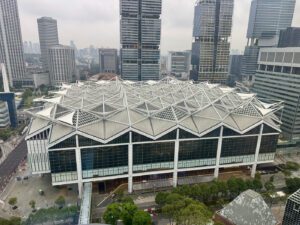
The program itself reflected a field broadening its reach. Alongside the main scientific sessions were pre-congress workshops and training courses, short flash talks linked to poster sessions, and mentoring and networking for early-career researchers. The Early Career Researcher (ECR) program also featured manuscript, poster and three-minute thesis competitions. HUPO continued its interactive Bioinformatics Hub format, with 11 sessions spanning AI, multiomics and reproducibility. One, led by the Human Protein Atlas, explored integrating multiomics data and AI tools into its resources.
The exhibition hall and industry-supported seminars added another dimension. Thermo Fisher Scientific and Olink shared a booth for the first time, while Illumina showcased proteomics approaches for population-scale studies. Both hosted scientific seminars. Their presence underscored how technology development, data analysis and clinical research are increasingly part of the same conversation.
An invitation from China
Fuchu He, PhD, chairman of the National Center for Protein Sciences in Beijing, set out an ambitious direction in the opening keynote. He leads the China-initiated Proteomic Navigator of the Human Body, or π-HuB, whose published roadmap envisages investment running into billions of renminbi over three decades.
Jing Yang, PhD, π-HuB’s secretary-general and a researcher at Guangzhou National Laboratory, described an effort to profile organs, tissues, cell types, and individuals, building a reference for how human biology changes over a lifetime.
The ambition is to “predict the proteomic states of each person across their lifetime,” he explained, accounting for influences including the microbiome, immune system, environment, and lifestyle. Reliable individual predictions remain a research goal.
“We really want to collaborate with HUPO,” Yang told GEN, describing discussions about extending cooperation beyond conferences and communication into science and funding.
Building a cell, together
Tiannan Guo, PhD, a professor at Westlake University, connected spatial proteomics and temporal perturbation proteomics with the development of AI-based virtual cell modeling. His presentation described proteomic work spanning 58 major tissue types, 251 more finely defined tissue types, and 25 carcinoma types, as well as a perturbation proteomics-based virtual cell model for triple-negative breast cancer with potential clinical benefits.
Guo’s virtual-cell framework brings together existing biological knowledge, cellular architecture, and dynamic measurements of responses to perturbations. Models would guide experiments, and the resulting measurements would test and refine their predictions.
The Westlake AI Virtual Cell–Yeast, or WAY, project divides that challenge into interconnected cellular functions, including metabolism, membrane systems, and stress responses. Task-specific AI agents would work together.
Contributors to the published framework include researchers affiliated with ETH Zurich, Stanford University, and the University of Toronto, among others.
Cells have to cope with lunch
Florian Rosenberger, PhD, a SciLifeLab fellow and assistant professor at Karolinska Institutet, gave an example of what a real cell must handle.
“Life is all about being able to deal with the little fluctuations,” he told GEN, including “being able to deal with lunch without dying instantly.”
His single-cell deep visual proteomics work investigates mitochondrial disease while preserving tissue context. Access to oxygen and nutrients varies between neighboring cells, as can the accumulation of mutations. Rosenberger compared the patchwork of cellular states to a Portuguese tile floor.
By isolating cells in different functional states and arranging them in an inferred sequence, or pseudotime, his group can investigate proteomic changes associated with deterioration. This reconstructs a possible progression rather than following the same cell through time. The aim is to distinguish responses associated with failure from those that might support resilience. Rosenberger stressed that this is early work, but understanding those responses could eventually inform research in other diseases involving mitochondrial dysfunction.
“What is the normal working range that a cell can have, and when does it tip over into disease?” he asked.
Fabian Coscia, PhD, head of the spatial proteomics group at the Max Delbrück Center in Berlin, described how cancer cells can differ in their response to treatment. Rare cell populations may carry protein states associated with resistance before treatment begins; others adapt during treatment. Comparing pretreatment and post-treatment samples helps investigate both possibilities.
In Alzheimer’s brain tissue, his group found that neurons with visible tau pathology and neighboring cells without it did not separate neatly into affected and unaffected categories. Proteomic measurements revealed intermediate states.
“You have an entire trajectory of states,” Coscia said. These are precisely the distinctions a predictive model will need to capture.
From tissue to accessible samples
Birgit Schilling, PhD, a professor at the Buck Institute for Research on Aging, spoke with GEN in Toronto the previous year. This year in Singapore, she described how her laboratory was now using spatial mass spectrometry to investigate human osteoarthritis, finding localized changes in bone that bulk analysis could obscure.
“What I’m particularly excited about is that we took that to then bring that back to a biomarker fluid,” she said. The team is following tissue-level discoveries with biomarker work in synovial fluid, the fluid within the joint.
Mitchell Lai, PhD, a senior lecturer in pharmacology at the National University of Singapore, examines Alzheimer’s biomarkers in an Asian cohort with substantial cerebrovascular disease, testing their usefulness beyond the Western populations that dominated earlier studies.
“Now we are more interested in prognostic biomarkers,” Lai said. He wants measurements that help anticipate future dementia and cognitive impairment.
His work with the NULISA technology, explores brain-derived phosphorylated tau. The assays recognize both a phosphorylation site and a brain-associated splice variant, distinguishing a more specific signal within circulating tau.
Lai emphasized that longitudinal research requires comparable assays even when samples are collected years apart.
Jochen Schwenk, PhD, who chaired HUPO’s Plasma Proteome Project over the past decade, noted a substantial increase in abstracts describing studies of human biofluids in large cohorts. He welcomed the trend but cautioned against drawing conclusions too early without considering findings from similar studies. He also highlighted growing interest in microsampling, which could make sample collection easier and broaden the role of proteomics in precision medicine.
Gabriel Mazzucchelli, PhD, head of the omics group in the University of Liège’s mass spectrometry laboratory, is exploring a different sample: sweat. His team has developed a spectral library containing around 4,000 proteins and conducted pilot work on treatment monitoring. An overnight collection patch under development could make repeated sampling possible without hospital visits.
Mapping protein forms and functions
The separate, closed Day of the Research Initiatives brought π-HuB, the Human Proteome Project, and the Human Proteoform Project together to discuss the field’s future.
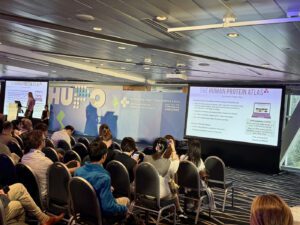
Neil Kelleher, PhD, director of Northwestern University’s Chemistry of Life Processes Institute, described the Human Proteoform Project’s ambition as having “the genome project moment for proteins.” Representing the Consortium for Top-Down Proteomics, he proposed a reference set of intact molecular forms of proteins across human cell types and body fluids, estimating 50–100 million distinct proteoforms.
His presentation argued that distinguishing those forms could improve biomarker selection, patient stratification, and drug-target decisions. “It is a structural project more than a functional one.”
The proposed reference would require roughly 10 years and $300 million–$500 million annually, he estimated.
Cecilia Lindskog, PhD, an associate professor at Uppsala University and chair of HUPO’s Human Proteome Project, described the complementary challenge.
“We want to determine the function of every human protein,” she said, noting that fewer than a third have well-characterized, experimentally validated functions. She wants shared standards, complementary methods, and potentially shared samples and joint pilot studies to help close that gap.
The Human Protein Atlasintroduced a helpdesk at the congress alongside a Bioinformatics Hub session on integrating multi-omics data and AI tools.
Coscia described workshops bringing imaging researchers, the Human Protein Atlas, and the mass spectrometry community together around data formats and integration. He called for better protocols, interlaboratory comparisons, and metadata that make experiments reproducible. He also cautioned that exploratory spatial proteomics remains largely a discovery technology; some findings may reach clinical practice through established methods such as immunohistochemistry.
Beyond the congress
At the gala dinner in the Flower Dome at Gardens by the Bay, there was plenty to discuss. Singapore’s population studies, China’s international initiatives, and the clinical questions running through the conversations gave “Proteomics Plus” substance: more ways to measure biology, more people contributing, and more demanding questions about what the results mean.
By the next HUPO, it would be great to hear how those models performed on new data and whether candidate biomarkers held up in larger, more diverse patient cohorts. The next step is to show not just what proteomics can measure, but which experiments and clinical decisions those measurements can improve.