
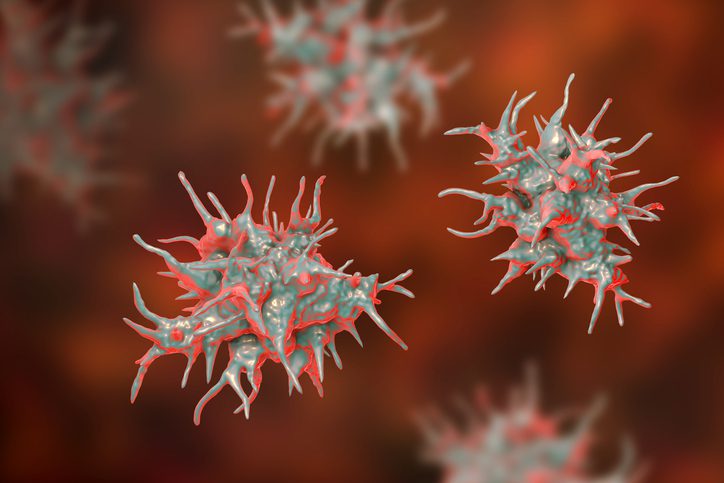
Starve Acanthamoeba of oxygen, and its mitochondria do not simply shut down. Instead, the organelles retool their energy-producing machinery, enabling the amoeba to generate hydrogen gas. Acanthamoeba is a free-living, single-celled organism found in water, soil, and air. Although it rarely causes disease, it can infect the cornea and cause sight-threatening keratitis—and its metabolic flexibility may help it persist there.
That adaptability is one of several defenses that make Acanthamoeba infections difficult to eliminate. The pathogen can also retreat into a drug-resistant cyst, and the treatments available once an infection is diagnosed are limited and may damage human cells. By mapping the organism’s mitochondrial proteins, researchers now have a new way to probe the machinery behind its survival and search for more selective therapeutic targets.
“It’s a big challenge. The lack of readily available diagnostics is a problem, and then even after you finally get to the diagnosis, we don’t have good drugs,” said Jon Stefely, PhD, a metabolism investigator at the Morgridge Institute for Research and assistant professor of biomolecular chemistry at the University of Wisconsin School of Medicine and Public Health. “Our current drugs are untargeted and toxic, and we just need more options for treating these infections.”
To begin expanding those options, Stefely and his colleagues created a high-confidence inventory of the proteins operating inside Acanthamoeba castellanii mitochondria. The experimentally defined mitoproteome reveals the pathogen’s metabolic flexibility while highlighting potential therapeutic vulnerabilities. Their paper, “Mitochondrial proteome of Acanthamoeba delineates aerobic and anaerobic pathways dynamically regulated by oxygen,” was published in Cell as part of the MitoCarta Tree of Life Consortium, along with their other paper published in Cell Press Blue, “Acanthamoeba castellanii genome reannotation and multiomic encystation profiling reveals cyst wall proteins and carbohydrate-active enzymes.” The consortium was conceived by Vamsi Mootha, MD, of the Broad Institute, Massachusetts General Hospital, Harvard Medical School, and Howard Hughes Medical Institute; Stefely completed the work as a postdoctoral researcher in Mootha’s laboratory.
In their Cell paper, the researchers first improved the organism’s nuclear genome annotation—important because most mitochondrial proteins are encoded in the nucleus—from about 52% accuracy to 98% using long-read RNA sequencing and other empirical methods. “If you imagine a page of words in a book, it would be like all the words were squished together and in a language that you don’t know,” said Stefely. “You would have to ask, ‘Where are the words? How do I separate one word from the next?’ It’s hard to tease apart.”
They then combined mitochondrial immunoprecipitation, density-gradient purification, microscopy, mass spectrometry, and protein-correlation profiling. Proteins that became enriched as mitochondrial samples grew purer were assigned to the organelle. Blue native PAGE–mass spectrometry for complexome profiling further resolved 20 macromolecular assemblies.
The resulting AcMitoCarta catalog contains 1,122 proteins, including 381 without readily identifiable counterparts in human or yeast mitochondria. Just over 300 were described as unique when compared with those organisms. Such divergence could matter for drug discovery: a compound directed at a microbe-specific protein or pathway may be less likely to damage human cells. “What’s been proven historically,” Stefely said, “is that if you have a target protein in a biochemical pathway that’s completely unique to the microbe, it’s a better target than something that has a homolog in humans.”
Proteomic and transcriptomic profiling also showed that oxygen extensively rewires the amoeba’s bioenergetic machinery. Under oxygen-rich conditions, its mitochondria use aerobic pathways; under anoxia, they induce a pyruvate:ferredoxin oxidoreductase-to-hydrogenase pathway. The researchers demonstrated that eye-infection-derived Acanthamoeba cells can produce hydrogen gas without oxygen through a mitochondria-localized, oxygen-sensitive hydrogenase. That metabolic switch may help the organism persist in changing niches, including the cornea.
AcMitoCarta now provides a framework for testing which of these unusual proteins are essential to amoebal survival, cyst formation, or oxygen adaptation. Stefely plans to investigate the candidates and pathways in focused groups, with collaborators contributing expertise in mass spectrometry, RNA sequencing, metabolism, structural biology, and imaging. “A long-term goal is to annotate functions for all of those targets,” he said, “but we’ll take them one small set at a time and there is a lot of potential for new discoveries.”
The catalog does not yet identify a ready-to-use drug, but it narrows the search to experimentally supported mitochondrial components and pathways that differ from those in people. By moving from an incomplete genome annotation to a functional map of oxygen-responsive mitochondrial biology, the work lays a foundation for more selective treatments against an infection whose toughest form can withstand today’s therapies.