
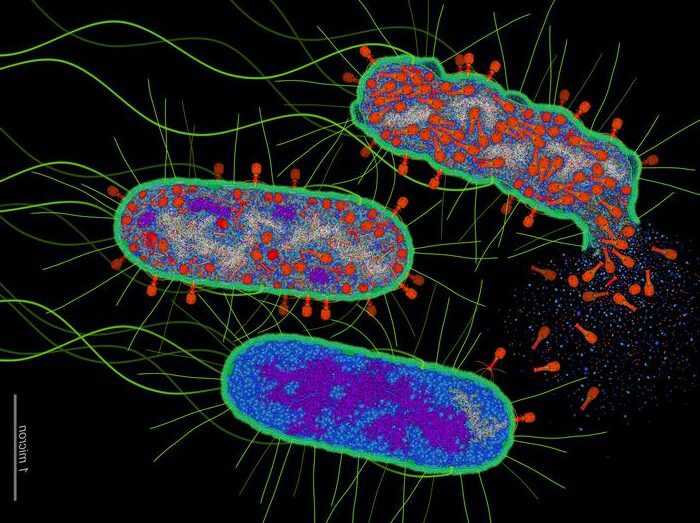
Phages continue to garner excitement as potential treatments for bacterial infections, with a particular interest in targeting infections that are growing increasingly more difficult to treat with antibiotics. There are several challenges in that area of development, including that bacteria have their own defense systems against viruses.
Now, new research has revealed that bacteria detect viruses when a viral enzyme cuts an important sensor molecule in the bacterium, kicking off the immune response. Discoveries of bacterial defenses can pave the way for the development of better phage therapies that can evade the bacterial immune system.
The results are published in Science in the paper, “Phage proteases activate CBASS antiphage immunity.”
“This is one of the most common forms of bacterial immunity, so when we finally figured it out, it was a total eureka moment,” said Sam Hobbs, PhD, assistant professor of biochemistry at University of Utah Health.
One component of the bacterial immune system is the cyclic oligonucleotide–based antiphage signaling systems (CBASS) which lead to a “last resort” immune response that kills the bacterium before viruses can spread to neighbors.
Precise sensing of the viral trigger is a necessity. In CBASS, cGAS/DncV-like nucleotidyltransferase (CD-NTase) enzymes sense phage infection and synthesize nucleotide signals to initiate antiviral defense. This new work found that the sensing mechanism detects a molecule that the virus needs to survive. More specifically, that phage prohead protease activity is a widespread mechanism of CD-NTase activation.
“We found that the protease from the phage actually acts directly on the host protein, and that is the signal that turns on the whole signaling pathway,” explained Hobbs.
This trigger mechanism is distinct when compared to related antiviral immune pathways, which are activated by the presence of viral genetic material. “This is a totally new mechanism for how these host proteins are activated,” Hobbs said.
Hobbs added that understanding CBASS may advance our knowledge of the human immune system. CBASS is related to a similar immune pathway in humans, indicating that this pathway has persisted at least since bacteria and humans had a common ancestor. And because bacteria have such a rapid life cycle, scientists can use them to very quickly answer questions about how the immune system works, which they can then test in models closer to people.
“The fact that these systems are conserved between bacteria and humans suggests that they’ve been maintained in these different organisms for that entire evolutionary trajectory,” Hobbs said. “The cells are telling us that this is a really important pathway because they’ve maintained it for billions of years. It’s incredibly fascinating, and it’s a cool window into what’s important in maintaining the ability to fight viruses.”