
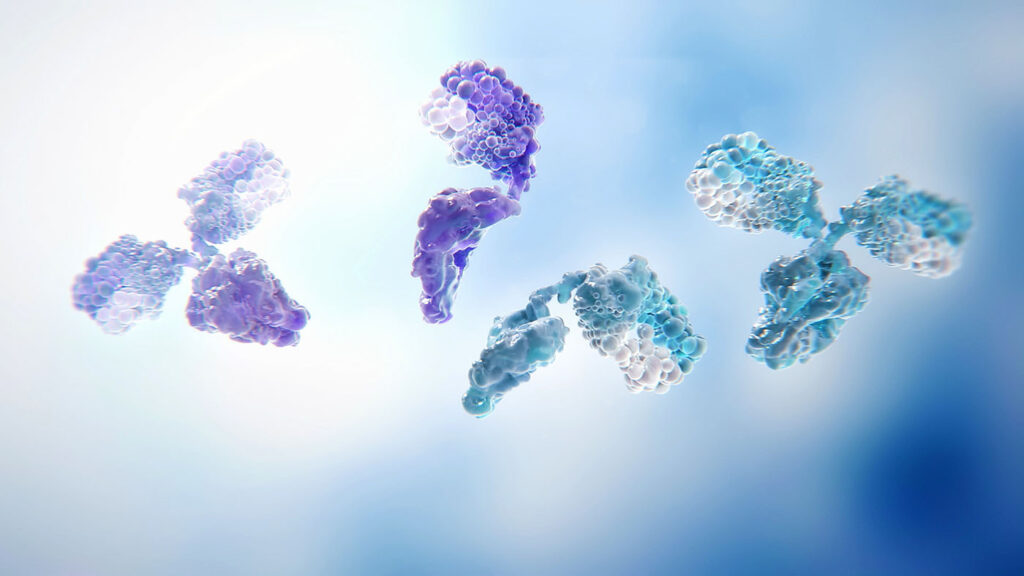
Antibodies have evolved by nature to possess exquisite selectivity for foreign targets to elicit an effective immune response, making particularly promising strides in advancing drug development for oncology targets and immunotherapies. Since the 1986 U.S. Food and Drug Administration (FDA) approval of the first monoclonal antibody, muromonab-CD3 (a mouse antibody used to prevent or treat organ transplant rejection), the diversity of antibody therapeutic strategies has evolved over decades to span immune checkpoint inhibitors, antibody-drug conjugates (ADCs), and bispecifics.
“Antibodies make great drugs because they solve a fundamental dilemma: how does the body fight off millions of unknown pathogens with so few genes?” said Bill Olson, PhD, senior vice president of therapeutic proteins at Regeneron, in an interview with GEN.
Regeneron’s antibody oncology pipeline covers a range of malignancies, including lung cancer, skin cancer, lymphomas, and multiple myeloma. At the American Society of Clinical Oncology (ASCO) meeting this past May, Regeneron announced results from the Phase III C-POST trial, which evaluated the programmed cell death protein 1 (PD-1) inhibitor Libtayo in patients with high-risk cutaneous squamous cell carcinoma (CSCC) after surgery.
Libtayo demonstrated a 68% reduction in the risk of disease recurrence or death and 80% and 65% reductions in the risk of locoregional and distant recurrence, respectively. PD-1 is a protein on the surface of T cells that acts as a “brake” on the immune system. Removing this “brake” by blocking PD-1 interaction enables the immune system to fight cancer.
Bispecific inflection point
Olson highlights that the first wave of conventional antibody therapeutics began by leveraging Fc receptors, key immune regulatory receptors connecting the antibody-mediated immune response to cellular effector functions. One early example is Rituximab, approved in 1997 to treat certain blood cancers and immune system disorders caused by overactive B cells, including non-Hodgkin’s lymphoma, chronic lymphocytic leukemia, and rheumatoid arthritis. Rituximab targets CD20, a protein involved in B-cell activation to inhibit disease-driving cells.
The next technology wave combined the selectivity of antibodies with cancer drug payloads, known as ADCs, to improve upon the untargeted and highly toxic effects of chemotherapy, which is unable to distinguish between healthy and diseased tissues. ADC payloads can include tubulin inhibitors and DNA damaging agents to be selectively targeted toward tumor cells.
ENHERTU®, a blockbuster ADC-based therapeutic developed by AstraZeneca and Daiichi Sankyo, which achieved global sales exceeding $1.6 billion in 2022, chemically links trastuzumab, a monoclonal antibody that targets HER2, a protein that plays a key role in normal cell growth and repair and is upregulated in breast cancer, with the topoisomerase I inhibitor payload, deruxtecan.
Tahi Ahamdi, MD, PhD, executive vice president, CMO, and head of experimental medicines at Genmab, emphasizes that antibody specificity is the key to the modality’s versatile applications.
“Why have there been so many antibody-based approaches? Because by nature, they’re very specific, which permits a wider therapeutic window for payloads in ADCs,” Ahmadi told GEN.
Ahmadi highlights that bispecific antibodies, which can bind to two different types of antigens simultaneously, were the next inflection point for antibody-based therapeutics.

Genmab’s Duobody platform generates bispecific antibodies that can perform simultaneous recruitment of immune cells and tumor cell recognition.
The Duobody technology begins by separately producing two parental immunoglobulin G (IgGs), the most common antibody found in blood circulation. After purification, the parental IgGs are brought together under controlled conditions that allow their dissociation into heavy-chain and light-chain pairs. Each IgG has a single matched mutation in the CH3 region that subsequently promotes heterodimerization of the half-molecules, forming the desired bispecific antibody product with two distinct fragment antigen-binding (Fab) arms.
As an example, acasunlimab is an investigational, bispecific antibody immunotherapy generated by Genmab’s Duobody platform and designed to elicit an antitumor response by targeting 4-1BB, a costimulatory receptor expressed in activated T and natural killer (NK) cells, and programmed death-ligand 1 (PD-L1), an immune checkpoint protein that suppresses cancer response. Acasunlimab is currently undergoing a Phase III study for patients with metastatic non-small cell lung cancer (NSCLC).
AI-designed specificity
In an interview with GEN, Israel Lowy, MD, PhD, senior vice president and oncology clinical development unit head at Regeneron, described antibodies as a foundational component giving rise to combinatorial approaches towards targeting cancer. He emphasizes that distinguishing healthy from diseased tissue remains an ongoing gap for these therapies.
“Cancer is just so challenging, especially solid malignancies,” said Lowy. “While we have great technologies for potentially eliminating the cells which express a given target, identifying targets that are exclusively found on the cancer and not essential to normal tissues remain a challenge.”
To improve specificity in immunotherapy, some groups have taken to artificial intelligence (AI) to develop antibody alternatives. In July, researchers from the lab of Nobel Laureate David Baker, PhD, published the design of highly specific, and low immunogenicity protein binders to recognize evasive disease markers for targeted cell killing.1 Baker is a Howard Hughes Medical Institute (HHMI) investigator and the director of the Institute for Protein Design at the University of Washington (UW).
When placed in CAR T constructs, binders triggered T-cell activation for the target peptide, but remarkably not for closely related peptides that were only one amino acid away. Binders were shown to recognize peptides from a diverse array of viral and tumor-associated proteins, including fragments from HIV and the tumor antigen, PRAME.
The Baker lab’s AI pipelines have also pointed to improving antibody structural design. A February preprint from the Baker lab demonstrated a technological advance in atomic precision by building antibody loops, the key regions responsible for binding, which have historically been a challenging design target due to their flexible nature.2 The work successfully designed and structurally validated antibody binding conformations for two disease relevant targets: hemagglutinin, a key protein found on the surface of influenza viruses, and a potent toxin produced by the bacteria, Clostridium difficile, using state-of-the-art de novo protein design model RFdiffusion.3
Linking sequence to function
Bay Area-based Abalone Bio focuses on a specific class of antibodies targeting G protein-coupled receptors (GPCRs), the largest protein family encoded by the human genome. GPCRs represent approximately one-third of drug targets yet are notoriously hard to hit as they reside deep in the cell membrane with barely any accessible regions. Additionally, GPCR family similarity makes drug selectivity challenging and can lead to off-target effects.

According to Richard Yu, PhD, CEO and co-founder of Abalone, GPCRs can offer a powerful mechanism for increasing internalization rates of cancer-targeting payloads, as these GPCRs are naturally desensitized by internalization driven by the adaptor protein beta-arrestin. However, effectively designing antibodies that hit GPCRs requires high throughput pipelines that can produce functional annotations for antibody sequences.
“If we can test a lot of things, nature can come up with very creative solutions to become more design minded. For some of these targets, there’s just not enough data out there,” Yu told GEN.
Abalone’s Functional Antibody Selection Technology (FAST) platform generates large scale data for sequence-function relationships to fill this gap. Yeast cells, a model for eukaryotic machinery, are engineered to measure the activity of a single antibody sequence variant in a massive parallel pipeline. Each of FAST’s yeast cells produces a functional human target protein and a single antibody variant per cell. The platform then generates growth curves to demonstrate the function for hundreds of millions of antibody sequences. These data are mined to discover rare hits in large antibody libraries and used to train protein large language models (LLMs) to generate optimized hits.
Clinically relevant
In contrast to yeast models, some groups have taken to apply human-centered data early on in antibody development. In July, Jura Bio, a genomic medicines company, announced VISTA, an AI-controlled data loop system to guide de novo antibody design with applications in cancer therapy.
VISTA emphasizes high clinical relevance by training the initial model on 320 million sequences from healthy humans with N-of-1 patient safety profiles. The platform then generates large-scale training datasets on tens of billions of sequence-target protein-protein interactions in a data loop steered with laboratory feedback. Jura is co-founded by George Church, PhD, renowned geneticist and professor of genetics at Harvard Medical School.
“When you move away from an extremely well-characterized modality, others may not value the criteria of our design programs as much as we do,” said Elizabeth Wood, PhD, CEO of Jura, in an interview with GEN. She highlights that showing success in antibodies is “more compelling” as a first proof-of-principle for the VISTA platform.

[Jura Bio]
Using VISTA, Jura has reported successful design of human antibody-derived single-chain variable fragments (scFvs) for tumor antigen targets, including MAGE-A4, a member of a family of cancer-testis antigens. These cancer-driving proteins have been historically elusive to target because of their intracellular location. Traces of these proteins are only revealed on the cell surface as short peptide fragments in a transient complex with human leukocyte antigens (HLA).
Wood notes that achieving reliable de novo designs provides a meaningful step toward scalable and cost-effective drug discovery pipelines in an industry where each drug candidate can be a “$2 billion liability” between discovery and market approval. In this vein, VISTA can complete testing of 100 million new antibody designs at the same time, a scale that would cost hundreds of millions of dollars if approached using brute force expenditure alone.
Taken together, evolving antibody technologies, from linking drug payloads, bispecific engineering to clinically relevant data sourcing, continue to advance oncology applications. The field looks ahead toward the next wave of antibody design, leveraging AI-based pipelines to tackle new cancer targets.
References
- Liu B, Greenwood NF, Bonzanini JE, et al. Design of high-specificity binders for peptide–MHC-I complexes. Science.2025;389(6758):386–391; doi: 10.1126/science.adv0185.
- Bennett NR, Watson JL, Ragotte RJ, et al. Atomically accurate de novo design of antibodies with RFdiffusion. Preprint. BioRxiv. 2025;2024.03.14.585103; doi: 10.1101/2024.03.14.585103.
- Watson JL, Juergens D, Bennett NR, et al. De novo design of protein structure and function with RFdiffusion. Nature. 2023;620(7976):1089–1100; doi: 10.1038/s41586-023-06415-8.