
Cancer metastasis is responsible for at least two-thirds of cancer deaths. Drugs targeting the metastatic progression have largely failed, in part due to the lack of predictive models that would help identify the underlying mechanisms of metastasis.
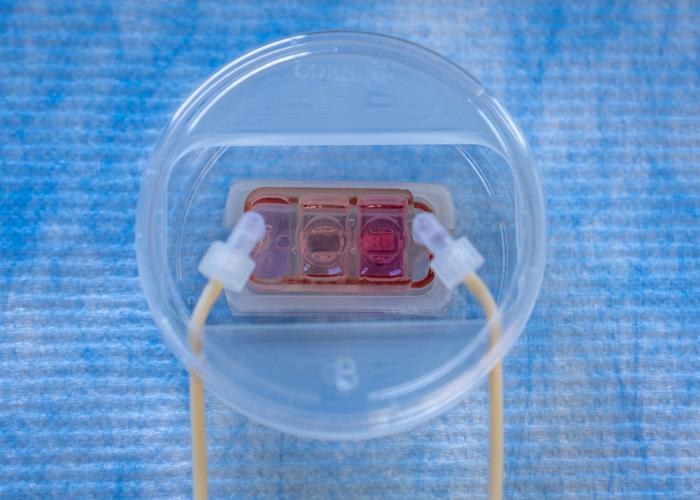
Now, new work reports the development of a multi-organ chip that mimics how cancer cells spread from vascular flow to distant organs—the first model of cancer metastasis of its kind. The chip includes compartments with millimeter-sized engineered human bone and lung tissues, and the vascular flow that contains circulating breast cancer cells and allows the dynamic cross-talk of the tissues being colonized.
“The key advantages of this advanced model of metastasis are that it is human and can be patient-specific,” said Gordana Vunjak-Novakovic, PhD, university professor and professor of biomedical engineering and professor of medical sciences at Columbia University. “It faithfully mimics some of the key aspects of human metastasis that are otherwise largely inaccessible for direct study.”
This work is published in Science Translational Medicine in the paper, “Organ-specific colonization and niche remodeling in a human tissue model of metastasis.”
“The pressing need for developing human tissue models of metastasis has been a key motivation for our study,” said Vunjak-Novakovic. “Our objective was to probe the ability of cancer cells to adhere to and traverse across endothelium [inner lining of blood vessels], and to determine their capacity to survive in the tissues they are colonizing through cell reprogramming and niche remodeling.”
The study sheds light on a critical phase of metastasis, known as organ colonization, which is difficult to study using animal models. The process is highly complex, requiring the cancer cells to evade tissue defense and adapt to the specific organs they invade.
The multi-organ chip allows scientists to investigate, in detail, metastatic progression with patient cells and tissues. The platform enables controlled experimentation of cancer cell-tissue interactions within organ-specific microenvironments, toward revealing molecular pathways and therapeutic targets for metastasis.
To demonstrate the chip’s capabilities, the team examined the colonization of circulating human breast cancer cells in bone and lung. Bone and lung, common sites of metastasis for breast cancer, and the vascular endothelium were engineered from induced pluripotent stem cells (iPSCs) using tissue-specific scaffold-bioreactor culture systems. The engineered tissues were maintained in individual compartments of the chip, which were each optimized for tissue maturation and long-term maintenance of functionality, and linked to each other by vascular circulation.
A selectively permeable endothelial barrier separates tissue compartments from the vascular channel, as in the human body. Once the platform was established, the researchers introduced breast cancer cells into the vascular circulation to observe patterns of organ-specific colonization. In line with what happens inside the human body, cancer cells that typically gravitate toward the bone showed stronger bone colonization and induced more pronounced bone degeneration. In contrast, cancer cells that typically gravitate toward the lung caused greater disruption in the lung tissue and only modest colonization of bone. Distinct patterns of tissue colonization and secreted factors demonstrate that this device mimics key features of organ-specific metastasis observed in the human body.
In addition, a post-analysis of the engineered tissue revealed that cancer cells condition the distant organs to be more receptive to colonization. The team saw signs of this process—called pre-metastatic niche formation—across both tissue compartments.
“Cancer is very smart, unfortunately. We learned how the cells cross barriers to get from blood circulation into the tissues,” said Vunjak-Novakovic. “We were also able to reproduce something that happens in patients, where cancer cells condition the target tissues, even before they colonize them, to make them more receptive.”
The work is aligned with the trend of more preclinical research in the future, including engineered human tissues that can complement what is learned from animal models. “As the FDA and NIH place growing emphasis on new approach methodologies, this study is a concrete example of what that shift can look like in practice, applied to one of cancer’s most challenging hallmarks: metastasis,” noted Ilaria Baldassarri, a PhD student at Columbia University.