
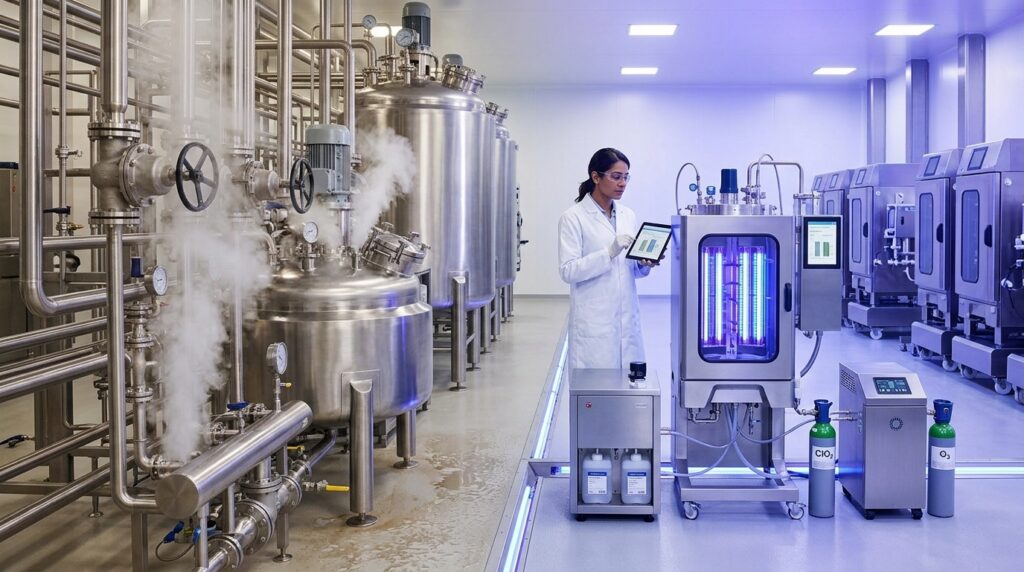
Biomanufacturing has spent years pushing the limits of biology. Yet scaling these treatments to more patients and diseases might depend on solving a less glamorous problem: sterilization.
Steam-in-place systems have long been the standard for keeping bioprocessing equipment sterile. They are proven, familiar, and infrastructure-intensive. Large installations can require extensive networks of hygienic piping and valves, along with substantial boiler capacity and specialized reactor vessels.
“Aseptic design is a critical constraint on biomanufacturing capacity and a major cost driver,” said Arye Lipman, COO and co-founder of Biosphere.
Biopharmaceutical manufacturers have spent roughly the past 15 years adopting disposable, single-use bioreactors that can sidestep some of the complexity associated with traditional sterilization. Their economics, however, are difficult to translate to industrial biotechnology, where production volumes can be orders of magnitude larger and margins substantially thinner. So, industrial producers are often left with conventional steam-based infrastructure.
“The industrial sector has been largely abandoned by biopharma equipment vendors,” Lipman said, arguing that producers frequently have to assemble bespoke systems around decades-old approaches.
The implications go beyond equipment costs. Complex aseptic systems can take longer to design, construct, validate, and commission. Maintaining sterile conditions at commercial scale also remains a persistent operational challenge, meaning advances in strain engineering do not necessarily translate into economical production. That mismatch is putting renewed attention on alternative sterilization technologies.
Several approaches are being investigated, including ultraviolet radiation, vaporized hydrogen peroxide, chlorine-dioxide gas, ozone, and supercritical carbon dioxide. Each presents different engineering trade-offs, but they share an objective: reducing dependence on the sprawling steam infrastructure traditionally needed to maintain aseptic operations.
Biosphere, for example, is developing a reactor architecture that uses UV radiation for sterilization. Lipman said the system is intended to dramatically reduce steam piping and boiler requirements while lowering the energy required for fluid sterilization.
If alternative approaches can prove reliable at industrial scale, the larger effect could be a change in the economics of where—and how—biomanufacturing plants are built. Facilities requiring less supporting infrastructure could potentially be constructed faster and at lower capital cost. That question is particularly relevant as the United States looks to strengthen domestic biomanufacturing capacity.
Lower capital requirements could also change how manufacturers manage technology risk. Instead of committing enormous sums to a single product and facility, companies could potentially distribute investment across smaller plants and expand the most successful processes later. Still, displacing steam will not be easy.
Alternative sterilization methods must demonstrate consistent performance from bench scale through commercial operation. They also need to integrate with downstream purification and other unit operations while delivering economics compelling enough to justify replacing familiar equipment.
“The chemicals industry is notoriously reluctant to adopt new technology,” Lipman said.
That conservatism means the next biomanufacturing breakthrough might not come solely from a better organism. Scaling the bioeconomy could depend just as much on redesigning the infrastructure surrounding it, and reconsidering a sterilization paradigm that has endured for generations.