
Sponsored content brought to you by

As genomic research tackles increasingly complex biological questions, researchers need tools capable of looking beyond the most readily resolved regions of the genome. Repetitive sequences, structural variation, and other complex genomic features can be challenging to resolve with many conventional sequencing workflows. At the same time, laboratories must balance accuracy and speed with practical considerations, including read length, throughput, batch size, and access to data.
Sequencing by expansion (SBX), the technology underlying Roche’s AXELIOS 1 platform, takes a different approach to these challenges by physically expanding the space between encoded bases before detection.
Creating space for a clearer signal
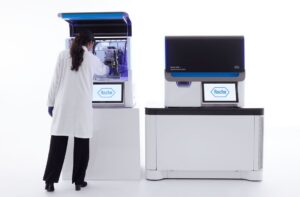
SBX leverages a specialized polymerase that converts the sequence of a target DNA or RNA molecule into a measurable surrogate polymer called an Xpandomer, using nucleotide analogs. The resulting Xpandomer is approximately 50 times longer than the original molecule, creating greater physical separation between encoded bases.
The Xpandomer is then measured as it passes through a reusable complementary metal-oxide semiconductor (CMOS) sensor containing millions of nanopores. Its high signal-to-noise reporters are designed to support accurate, ultra-rapid single-molecule sequencing with near real-time base calling and analysis. This architecture may help researchers investigate a range of genomic features, including single nucleotide variants, insertions and deletions, copy-number alterations, repetitive sequences and other complex structures.
Flexibility beyond chemistry
The utility of a sequencing technology depends on more than chemistry alone. Research needs can vary substantially from one project to another and even within the same laboratory. AXELIOS 1 pairs SBX chemistry with a sequencing architecture designed to accommodate that variability. The system offers configurable batch sizes, allowing researchers to run smaller batches without waiting to accumulate enough samples for a larger run.
Researchers can also adjust read length according to experimental needs, with reads up to approximately 1,500 base pairs (with a distribution from ~200bp to ~1500 bp) under appropriate sample and library preparation conditions. The platform is capable of end-to-end, same-day whole genome sequencing (WGS) in research workflows, while near real-time base calling and analysis enable access to data as a run progresses.
This flexibility extends across multiple research applications. SBX has been tested in proof-of-principle studies for WGS, RNA sequencing (RNA-seq), single-cell RNA sequencing (scRNA-seq), spatial analysis, and methylation studies. For each application, the AXELIOS 1 Platform sequences Xpandomer molecules that were created from libraries made with the AXELIOS 1 DNA Library Prep Kit. The data is then analyzed using the no-cost, open-source XOOS bioinformatics analysis suite tailored for SBX. Collaborations also support applications and tools across the sequencing ecosystem, including support for SBX through Google DeepVariant.
Broadening the genomic picture
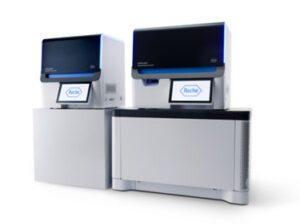
Modern genomics rarely relies on a single experimental approach. Researchers may need to examine genomic variation, gene expression, cellular heterogeneity, or epigenetic changes to build a more complete biological picture. Sequencing platforms that accommodate different applications and project sizes can allow laboratories to design workflows around the scientific question rather than instrument constraints.
By combining a new approach to sequencing chemistry with flexible read lengths, batch sizes, and research applications, AXELIOS 1 is designed to expand the range of genomic questions researchers can pursue. As sequencing continues to evolve, these capabilities could help scientists interrogate previously challenging regions of the genome and build a more complete foundation for biological discovery.
For Research Use Only. Not for use in diagnostic procedures. AXELIOS is a trademark of Roche.

To learn more, visit go.roche.com/AXELIOS1article