
Sponsored content brought to you by

As neurodegenerative disease research shifts toward blood-based diagnostics, the demand for assays capable of detecting biomarkers at vanishingly low concentrations has never been greater. Neurofilament light chain (NFL), glial fibrillary acidic protein (GFAP), phosphorylated Tau (pTau217), and amyloid beta (Aβ1-42) are among the most clinically informative markers of neurodegeneration, neuroinflammation, and amyloid pathology in Alzheimer’s disease (AD), but their extremely low abundance in blood has long limited routine, scalable testing.
Traditionally, these biomarkers have been measured in cerebrospinal fluid (CSF), a matrix that closely reflects brain biology but requires invasive collection, limiting its use in large-scale or routine clinical studies. Blood-based alternatives offer a more accessible and scalable path forward, and are already becoming a clinical reality, with approved tests now available for conditions such as Alzheimer’s disease and multiple sclerosis. Realizing that promise more broadly, however, demands analytical methods that combine ultra-high sensitivity with robust precision and standardized, low-variability workflows.
Precision at the femtogram level
Simple Plex Ultra-Sensitive Assays on the automated Ella system were developed to meet this challenge. Built on the same integrated microfluidic cartridge format that enables precise control of assay parameters, the Ultra-Sensitive versions of the NFL, GFAP, pTAU217 (ALZpath), and Aβ1-42 assays extend detection into the femtogram-per-milliliter range- while still delivering fully automated results in under three hours.
Across multiple cartridges and lots, standard curves spanned approximately 3–4 logs, with all points within the limits of quantitation recovering 80–120% of target concentrations and coefficients of variance (CV) below 20%. Functional limits of detection reached as low as 0.05 pg/mL for pTau217, with functional lower limits of quantitation as low as 0.13 pg/mL, sensitivity which is sufficient to detect all four biomarkers in 100% of plasma samples from a cohort of 24 healthy donors.
Distinguishing healthy from diseased
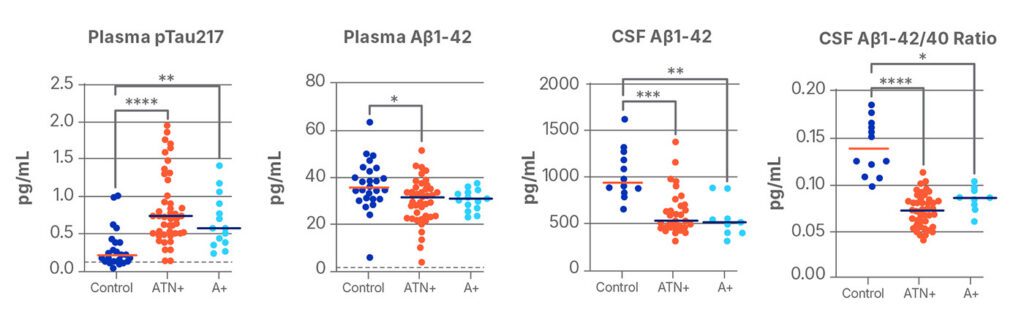
Sensitivity alone isn’t enough; an assay must also translate into meaningful differentiation across clinical research samples. When plasma and serum samples from healthy donors were compared against those from Alzheimer’s disease patients, the Ultra-Sensitive assays clearly separated the two groups. Serum NFL and GFAP each achieved a receiver operating characteristic (ROC) area under the curve (AUC) of 0.90, while plasma pTau217 and the pTau217/Aβ1-42 ratio reached AUCs of 0.88 and 0.89, respectively. Incorporating Aβ1-40 measurements to derive an Aβ42/40 ratio in CSF pushed discrimination even further, to an AUC of 0.98—underscoring the complementary, multi-modal value of pairing these biomarkers.
Confidence in a biomarker result depends on more than a single strong run. Intra-assay precision across all four assays showed CVs of just 1.8–5.8%, while inter-assay reproducibility—assessed across eight operators, more than 23 Ella instruments, 68 cartridges, and three cartridge lots—remained consistently strong. Parallelism and spike-recovery studies further confirmed minimal matrix interference, with average recovery values of 99–118% across the assays.
Cross-platform comparisons added another layer of validation: Ultra-Sensitive measurements of blood pTau217 and GFAP correlated strongly with results from an independent bead-based immunoassay platform, with spearman coefficients of 0.92 and 0.91, respectively. The Ultra-Sensitive assays also showed high commutability with standard Simple Plex formats, giving labs a clear path to adopt greater sensitivity without disrupting established workflows.
A new era in blood-based neurology
Together, these results position the Simple Plex Ultra-Sensitive Assays on Ella as a precise, highly sensitive, and fully automated solution for quantifying neurodegenerative biomarkers directly in blood. By combining femtogram-level sensitivity with a standardized microfluidic workflow, researchers gain a reproducible, scalable tool suited to the next generation of studies into the onset and progression of Alzheimer’s disease and other neurodegenerative conditions—without the need for invasive CSF collection. As blood-based detection continues to reshape neurology research and platforms capable of delivering this combination of sensitivity, precision, and throughput will be essential to translating biomarker discovery into real-world clinical research.

Learn More rndsystems.com/ella