

Co-founder and CEO
Marama Labs
Characterizing the RNA and ligands in nanoparticle-based therapeutics has, historically, been a cumbersome process. The lipid nanoparticles (LNPs) that encase RNA and payloads are cloudy by nature, which means analysis can’t be accomplished using the UV/Vis spectrometers that are ubiquitous throughout the life sciences industry.
Marama Labs has developed a technology that eliminates the light scatter in cloudy samples—even in samples as cloudy as milk—thereby “unlocking a huge capability for complex particle analysis,” Brendan Darby, PhD, co-founder and CEO of Marama Labs, tells GEN.
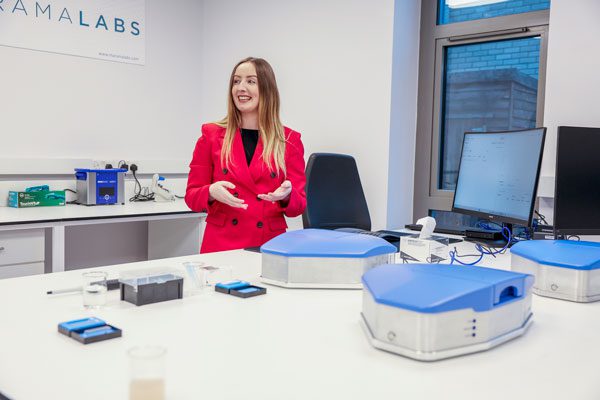
The technology, CloudSpec, employs scatter-free absorbance to remove the signal interference caused by a solution’s cloudiness, in effect, chasing away the clouds. To do this, Darby and colleagues created a highly reflective spherical chamber called an integrating sphere, which harnesses the properties of physics—specifically, the Beer-Lambert Law regarding light attenuation—and an algorithm to precisely measure analyte concentrations. This enables clean measurements similar to those of a standard spectrometer. Using this device, LNP lysing and fluorescent dyes are unnecessary for payload quantification.
Research from Victoria University of Wellington (New Zealand), University College Cork (Ireland), and Marama Labs indicates this analysis method outperforms fluorescence-based quantification assays in terms of precision and agreement with expected RNA concentrations.
CloudSpec delivers results across the 240 to 850-nm spectral range that are “within 10% of the nominal value expected for RNA concentration,” Darby says. And, he adds, “The technique is very precise.” It’s also fast and simple. Sample dilution is the only preparation needed, and the measurement itself takes only 15 seconds.
Alternative technologies, in contrast, he says, can involve eight to 10 steps and between 30 minutes and two hours to analyze each sample, with significant variability between samples and also between operators.
Physics, wine, and RNA
The idea for this novel quantification technology emerged during Darby’s doctoral work in the RAMAN Lab of Eric Le Ru, PhD, professor at Victoria University of Wellington, now Marama Labs’ CSO.
“We were trying to understand how light interacts with nanoparticles from a very fundamental physics point of view,” Darby recalls. “We were looking at the fundamental optics of scattering and light absorbance with nanoparticles and found that what we were trying to measure was impossible with the existing instruments at our university. We realized that light scattering was causing a major source of error in measurements.”
“Most liquids are cloudy by nature, unless they are purified in a lab or filtered. When we (produced) the same quality and repeatability as UV/Vis, but in unprocessed samples, we immediately understood that this technology could potentially become the gold standard for characterization of complex samples,” Darby says. UV/Vis, he explains, measures extinction—both scatter and absorption. CloudSpec, however, measures extinction and absorption directly and uses those measurements to determine scattering.
At that point, Darby, Le Ru, and Matthias Meyer, PhD, CTO and co-founder, began the process of forming Marama Labs, which was incorporated in 2019.
In his thesis research, Darby measured molecules on the surface of metallic nanoparticles at ultra-low, previously unmeasurable, concentrations accurately. That finding was extended to RNA therapeutics and validated in collaboration with CureVac researchers.
From the beginning, though, the team understood that CloudSpec’s greatest contributions would be in the life sciences, but its first applications were in the New Zealand wine industry.
“Winemakers in New Zealand are very technology-centric and innovative,” he says. At the time, “There was no easy method to measure color and tannin at the very earliest stage of winemaking. They used their palettes and their eyes.” CloudSpec’s advanced analytics provided the data that those winemakers needed to better control their processes and thus craft the style of wine they needed for their market needs, while, he says, “being respectful of the grape.”
To transition to life sciences, the challenge was how to evolve the technology and apply learnings from the wine industry to the pharmaceutical industry. “Our primary focus is in life sciences and RNA therapeutics,” he reiterates.
Formulations to QA
Currently, most of CloudSpec’s applications are in therapeutic formulation development. There, this technology helps companies optimize formulations to provide both effective nanoparticle delivery and effective therapeutic response. Additional applications include manufacturing and quality assurance.
CloudSpec technology is currently single-parameter focused, measuring RNA and targeting-ligand concentrations. While these are quite important, they are only one of several chemical and physical parameters that must be measured. The size of the nanoparticles, their distribution, and surface charge, for instance, are among the critical quality parameters that biomanufacturers must measure.
With that in mind, Darby hints that an additional measurement capability “for one of the most widely-used attributes in the LNP formulation space” may be added to the CloudSpec soon. “It’s been demonstrated and validated internally that CloudSpec can do this measurement, and do it faster and more repeatably than the existing method. We don’t just add on capability for the sake of adding,” he stresses. What that new measurement is couldn’t be released at the time of the interview.
In addition to expanding its technology, Marama Labs is also growing its global presence. Its core research and development team and manufacturing facilities are based in Wellington, NZ. Darby heads the company’s commercial and strategic development from his office in Dublin. The company also recently opened an office in Boston to support its growing customer base there.
That combination provides access to the major European and North American markets while maintaining close ties to its innovation team, effectively chasing away the clouds wherever LNP analysis is performed.