
September 15, 2010 (Vol. 30, No. 16)
Eric Steinmetz, Ph.D.
Julie Boyum
Jan Deneke, Ph.D.
David A. Mead, Ph.D.
System Simplifies Target Gene Cloning and Soluble Protein Expression in E. coli
Recombinant protein expression is an essential pillar of biomedical research. Efforts from enzyme discovery to protein structure-function study to development of drugs and biological therapeutics all share a need for reliable production of soluble, active, purified protein.
A popular approach to expression in E. coli exploits the high promoter specificity and transcriptional activity of bacteriophage T7 RNA polymerase. Target genes can be expressed to high levels from T7 promoters, but only in host strains that express T7 RNAP such as BL21(DE3). This strain harbors the T7 RNAP gene under control of the lacUV5 promoter, enabling inducible polymerase expression in response to lactose or IPTG.
Despite these advantages, many heterologous proteins (up to 50%) are improperly folded and insoluble when overexpressed in E. coli. Furthermore gene products that are toxic to E. coli can be difficult to express from T7 promoters, in part due to leaky expression of T7 RNAP in BL21(DE3).
Lucigen has developed the Expresso™ T7 Cloning and Expression System to improve the speed, efficiency, and success of target gene cloning and soluble protein expression in E. coli.
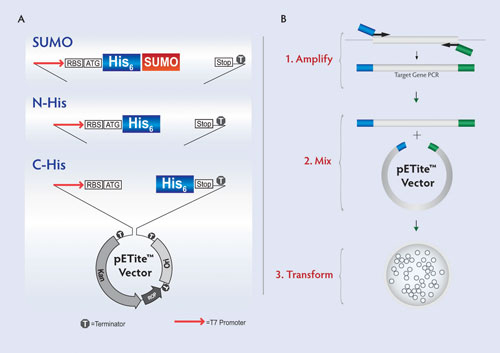
Key features of the Expresso System include HI-Control™ host strains with enhanced control over leaky expression, and pETite™ T7 expression vectors built upon Lucigen’s transcription-free pSMART® vector backbone (Figure 1A).
The vectors and hosts function together to provide tight control without compromising high levels of induced expression. The system implements an enzyme-free cloning strategy that simplifies the design and construction of expression clones.
Like many other T7 vectors, the pETite T7 vectors have a lac repressor binding site (lac operator, lacO) positioned adjacent to the T7 promoter to help prevent leaky transcription by the phage polymerase.
The lac repressor performs double duty in most T7 expression systems, since the T7 RNA polymerase gene in BL21(DE3) cells is under the control of lacO sites in the lacUV5 promoter. Because lac repressor normally accumulates to a low level of ~10 molecules/cell, an increased dosage of the repressor protein is required to maintain occupancy of both the T7-lac vector and lacUV5 operator sites. Many traditional T7 vectors thus harbor a copy of lacI, the gene encoding lac repressor.
The Expresso System takes a different approach to increased lac repressor dosage. The HI-Control host strains harbor a stable, single-copy mini-F plasmid carrying a specially engineered lacI gene that expresses ~200-fold more lac repressor protein than native chromosomal lacI, providing enhanced control over leaky expression.
The abundant repressor protein within the HI-Control BL21(DE3) cells not only controls expression of T7 RNAP from the lacUV5 promoter, but also is available to occupy the lac operator site on the expression vector. The pETite T7 vectors need not carry the lacI gene, and at 2.2–2.5 kb are much smaller than typical pET vectors (~5.5 kb). The reduced vector size improves cloning efficiency, accomodates larger genes or operons, and simplifies downstream manipulations such as site-directed mutagenesis.
The Expresso System combines these vector/host enhancements with an enzyme-free recombination strategy for directional cloning of PCR products (Figure 1B). The Expresso method requires no clean-up or enzymatic treatment of PCR reaction products. A protein-coding gene is amplified using gene-specific primers that append distinct 18 base-pair sequences matching the vector sequence flanking the insertion site.
After the PCR product size and yield are confirmed by agarose gel analysis, an aliquot (typically 1 µL) of unpurified PCR product is co-transformed with pre-processed pETite T7 expression vector into HI-Control 10G chemically competent cells. Recombination between the vector and PCR product within the host cells precisely fuses the target gene to the vector in the proper orientation.
The low background of empty clones with preprocessed pETite vectors and the high transformation efficiency of the HI-Control 10G competent cells simplify the identification of positive clones. For most genes, >90% of colonies will have the target gene correctly inserted into the vector. Confirmed clones are transferred to HI-Control BL21(DE3) cells for protein expression.
Elimination of the requirement for restriction digestion and ligation not only saves hours to days of vector preparation, sample incubation, and clean up time, but also simplifies the design of expression clones. Seamless fusion to the vector eliminates undesirable amino acids encoded by restriction sites. Endpoints of the target protein can be selected at will and additional sequences can be introduced via primer design as desired.
Figure 1. Enzyme-free cloning with pETite Vectors: (A) The pETite Vectors include a choice of N-terminal or C-terminal 6xHis tags or an N-terminal 6xHis-SUMO tag for enhanced soluble expression. Kan: kanamycin resistance gene; Ori: origin of replication; ROP: repressor of primer (control of copy #), RBS: ribosome binding site. Translational start (ATG) and stop codons are included in the vectors. (B) The Expresso enzyme-free cloning strategy.
Lucigen currently offers Expresso T7 cloning and expression kits with pETite vectors in three configurations. For routine protein purification by immobilized metal affinity chromatography (IMAC), pETite T7 N-His and pETite T7 C-His Vectors allow fusion to amino-terminal and carboxyl-terminal 6X histidine tags, respectively. Figure 2 shows an example of high-level expression and purification of soluble fluorescent protein with a C-terminal 6xHis tag.
For proteins that are difficult to express in soluble form, the new pETite SUMO vector allows expression of target proteins with an amino-terminal 6xHis-SUMO protein tag.
SUMO (small ubiquitin-like modifier) is a relatively small (100-residue) polypeptide that has been shown to enhance the soluble expression of many proteins that are otherwise difficult to produce in E. coli. After IMAC purification of the N-His-SUMO-tagged protein, the tag portion can be removed precisely by SUMO protease.
The SUMO protease recognizes the tertiary structure of SUMO rather than a short recognition sequence and cleaves precisely at the junction between the SUMO tag and the target protein, with no off-target cleavage. Both the SUMO protease, which is 6xHis tagged, and the cleaved N-His-SUMO tag can then be separated from the released target protein by subtractive IMAC.
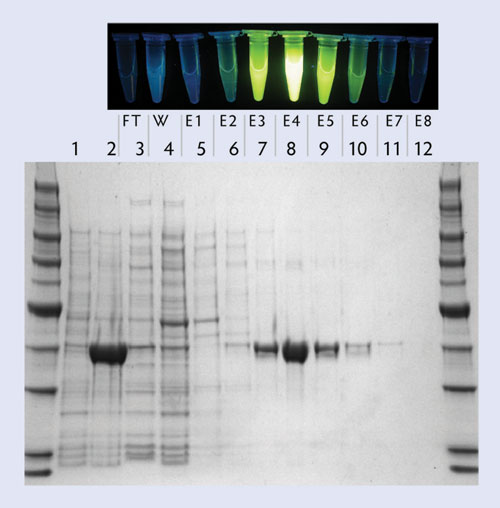
Figure 2. Purification of a 6xHis-tagged fluorescent protein: HI-Control BL21(DE3) cells harboring a yellow fluorescent protein (YFP) gene in the pETite C-His Vector were induced with 1 mM IPTG for 4 hours (lane 2); uninduced cells are shown in lane 1. Cleared cell lysate was loaded onto an Ni-NTA Sepharose® column. Column flow-through (lane 3, FT) and wash (lane 4, W) fractions were collected. The bound YFP was eluted with buffer containing 300 mM imidazole (lanes 5–12, E1–E8). Fluorescent fractions align with the pure recombinant protein as shown on the gel.
We have used the Expresso T7 Cloning and Expression System for expression and purification of a variety of proteins. Some results of an ongoing large-scale expression study to identify hydrolase enzymes from Fibrobacter succinogenes are presented in Figure 3. Initially, 48 genes were selected for expression trials and cloned into the pETite C-His Vector.
Approximately half of these clones have produced soluble, active hydrolase protein, while in other instances target proteins were expressed in an insoluble form. Five of the genes producing insoluble proteins were re-amplified and cloned into the pETite SUMO vector. When the resulting clones were expressed in HI-Control BL21(DE3) cells, recovery of active protein in the soluble fraction was significantly improved in four of the five cases. Although tag removal was not necessary for hydrolase activity, the tag could be removed efficiently by SUMO protease.
The cloning strategy outlined here makes the Expresso System well-suited to high-throughput cloning and expression studies. The convenience of preprocessed vector, elimination of multiple enzyme treatment and clean-up steps, and improved control over leaky expression should also prove beneficial to researchers.
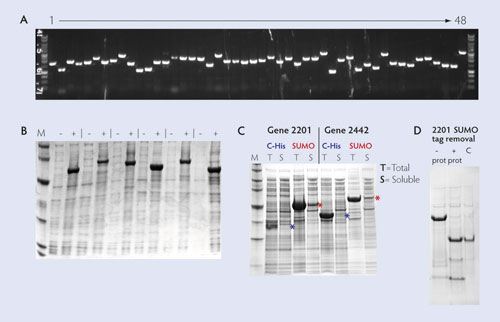
Figure 3. Large-scale cloning and expression case study: (A) PCR products from 48 putative hydrolase genes ranging from ~1 to >3 kb. (B) Uninduced (-) and IPTG-induced (+) samples of HI-Control BL21(DE3) cells with 6 different genes cloned into the pETite C-HIS Vector. (C) Enhanced solubility of SUMO-tagged 2201 and 2442 gene products. Total cell extract and soluble fractions are shown. (D) Removal of 6xHis-SUMO tag from purified SUMO-2201 fusion protein by SUMO protease. –prot: uncleaved SUMO-2201 fusion protein after IMAC purification; +prot: SUMO protease-treated fusion protein; C: isolated 2201 protein after removal of 6xHis-SUMO fragment and SUMO protease by subtractive IMAC.
Eric Steinmetz, Ph.D. ([email protected]) is a senior scientist, Julie Boyum is a research scientist, Jan Deneke, Ph.D., is a senior scientist, and David A. Mead, Ph.D., is CEO and founder of Lucigen.