
April 15, 2009 (Vol. 29, No. 8)
James P. Brady, Ph.D. Director of Technical Applications MaxCyte
Karen A. Donato, Ph.D. Exective VP MaxCyte
New Tool Designed to Provide High-Efficiency Transfections with any Molecule in all Cell Types
Process bottlenecks in high-throughput screening (HTS) can significantly diminish the productivity of a drug discovery program. One major and costly bottleneck within the drug discovery process is the creation of the modified cells needed for HTS cell-based assays for screening drug candidate libraries. A related bottleneck is the inability to transfect certain cells types and to load relevant agents such as mRNA, proteins, and small molecules.
Cells for HTS cell-based assays are commonly modified to express genes that produce proteins for drug targets. Traditionally, cell lines are modified for stable integration and expression of the target gene; this process can be long and time-consuming, often taking several months to create a stable clone. Another option is to transfect cells with the target genes to produce a transient response of several days. Drug discovery groups are increasingly using transiently transfected cells because of the savings in time and other resources versus the creation of stable cell lines.
Among commonly used transient transfection techniques are transfection with lipid-based reagents and cell transduction with viral vectors. Both methods have significant limitations. Reagents for transfecting cells on the multibillion cell scale required for HTS campaigns are expensive, and not appropriate for all cell types and loading agents. Limitations of viral vector-based transductions include the time and cost of vector production and scale-up, cell defense responses to viral vectors, and a limited range of transducible cell types.
To expand the range of cell and loading agent combinations and to overcome the limitations of other transient transfection methods, MaxCyte has introduced the MaxCyte® STX™ Scalable Transfection System, based on its flow electroporation technology.
How STX Transfection for HTS Works
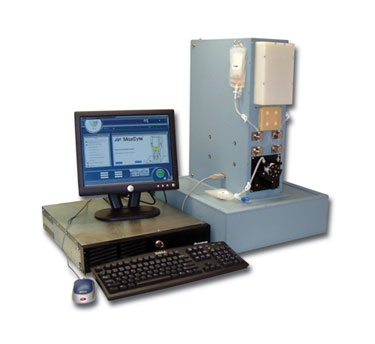
The MaxCyte STX (Figure 1) is a benchtop instrument controlled by an integrated computer. To prepare cells for HTS runs, the MaxCyte STX uses a simple, sterile procedure to transfect up to 10 billion cells in under 30 minutes. First, cells harvested from large-scale culture systems, along with the molecules to be transfected, are suspended in MaxCyte’s protein-free electroporation buffer.
The suspended cells are aseptically transferred to a sterile processing assembly, which is then installed on the MaxCyte STX. The MaxCyte STX computer comes preprogrammed with transfection protocols for common HTS cell types such as HEK293 and CHO cells. The user selects a cell transfection protocol and clicks the start button. This activates computer-controlled valves and an air pressure system that regulates the flow of cells through the MaxCyte STX electroporation chamber.
Inside the chamber, a series of electrical pulses tailored to the selected cell type loads the molecules into the cells as they flow between the electrodes. Cells emerging from the electroporation chamber then flow into a cell collection chamber. After a short incubation, the cells are ready for culture or cryopreservation. This MaxCyte STX instrument can also be used in a small-scale static mode to modify cells in the quantities appropriate for assay development.

Figure 1. The Maxcyte STX Scalable Transfection System can transfect a few million cells in seconds and up to ten billion cells in less than 30 minutes.
Transfecting Cell Lines
The MaxCyte STX can transfect with high efficiency essentially any mammalian cell line, differentiated human primary cell type, or human stem cell of interest to HTS studies. The data in the Table is representative of the cell types that have been efficiently transfected using the MaxCyte STX.
All electroporations use plasmid DNA encoding green fluorescent protein (GFP) as a marker of transfection efficiency (expressed as the percentage of GFP-positive cells at 24–48 hours post-transfection). Cell viability for the same period is the percentage of cells excluding propidium iodide (PI). For many cells, transfection efficiency and viability are often >90%. Figure 2 shows Vero and HEK293 cells that have been transfected with GFP plasmid; bright field and fluorescent images are shown 24 hours after electroporation with the MaxCyte STX.
The MaxCyte STX can also be used to transfect primary cells and stem cells, which are difficult to transfect by other methods. These types of cells are increasingly being considered for use in cell-based assays because they are more biologically relevant than cell lines.
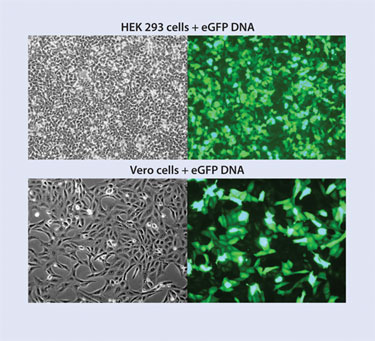
Figure 2. Using the MaxCyte STX, HEK 293 and Vero cells were transfected with eGFP plasmid DNA.
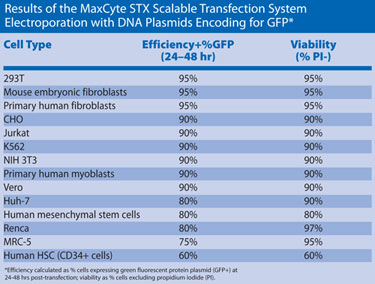
Table
Reproducible Loading
To demonstrate that MaxCyte STX transfections meet HTS requirements for scalability and reproducible loading of agent molecules, MaxCyte transfected six billion K562 cells in about 20 minutes in the MaxCyte STX electroporation buffer containing GFP plasmid DNA.
Figure 3 shows the results of transfecting an aliquot of 40 million cells by small-scale static electroporation and the remainder by large-scale flow electroporation. At 48 hours post-transfection, the large, HTS-scale flow electroporation (red bar) and small-scale, static electroporation (blue bar) yielded almost identical levels of K562 cell viability (>95%) and GFP-positive transfection efficiency (>80%).
Analysis of 28 cell fractions collected at equal time intervals during flow electroporation demonstrated that cell viability and transfection efficiency were highly reproducible and consistent from the beginning through the end of the process.
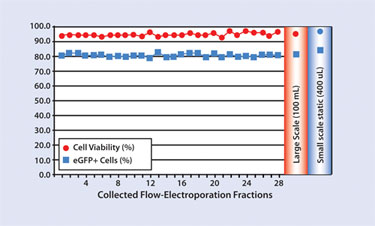
Figure 3. The MaxCyte STX was used to transfect K562 cells with pCMV-eGFP, illustrating its utility for loading suspension cells in large volumes (6×10⁹ cells in 100 mL in ~20 minutes).
Other Agents
The MaxCyte STX electroporation process makes it possible to load other agents into cells besides DNA, including labile mRNA and siRNA, proteins and protein complexes, cell lysates, and small molecules. The problem of RNA degradation is minimized by the rapid transfection process in which RNA is added to the buffer immediately prior to electroporation.
Expression levels can be controlled by adjusting the loading agent concentration. Transfecting multiple molecules in defined stoichiometric ratios to create specific complexes is also possible with the MaxCyte STX.
The MaxCyte STX can remove time and cost bottlenecks for preparing cell-based assays for HTS campaigns by rapidly transfecting large batches of cells with high-efficiency, cell viability, consistency, and reproducibility. Furthermore, by enabling high efficiency transfection with any exogenous molecule into any cell, including human primary cells and stem cells difficult to transfect by standard methods, the MaxCyte STX may help HTS advance in a more biologically relevant direction.
James P. Brady Jr., Ph.D. ([email protected]), is the director of technical applications, and Karen A. Donato, Ph.D., is executive
vp, sales and marketing at MaxCyte.
Web: www.maxcyte.com.